Theory and Method
Electroporation uses an electric field to create transient pores in the cell membrane. During this short window, nucleic acids or other payloads can enter the cell, followed by membrane resealing during recovery. QualiEP™ Adv supports two common pulse strategies:
- Exponential decay pulse: Energy delivery is governed by an RC network. Adjusting capacitance and resistance changes pulse energy and decay profile.
- Square wave pulse: Delivers a more constant field for a controlled duration, often used when protocols specify a fixed pulse length.
Typical workflow
- Prepare cells and payload in an appropriate electroporation buffer.
- Load the mixture into a compatible cuvette.
- Select pulse form (exponential or square), voltage range, and capacitance settings.
- Set discharge time and interval time, and choose continuous discharge count if required.
- Apply the pulse, then immediately recover cells in growth media and proceed to culture or analysis.
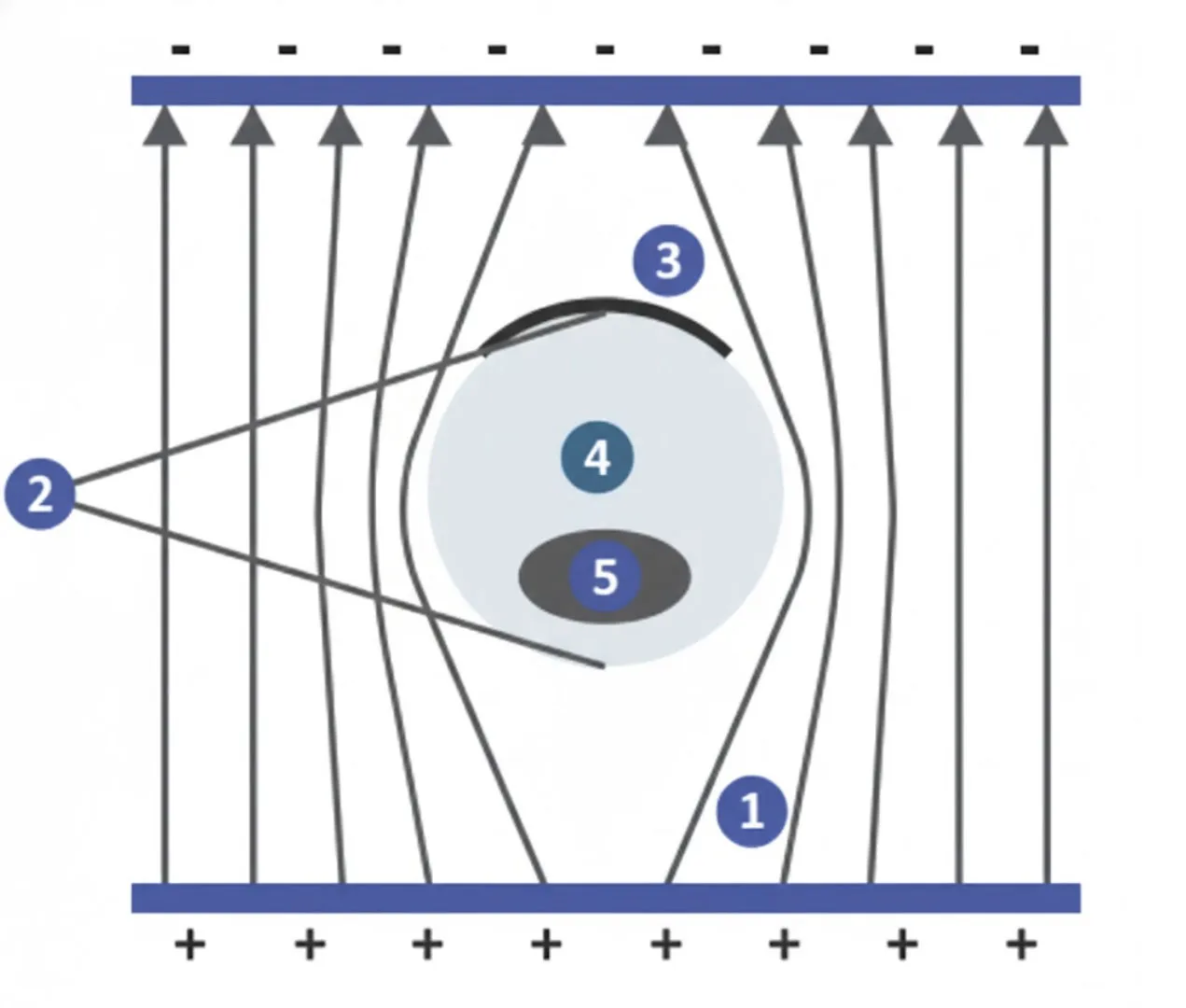
Based on the visual cues, this diagram illustrates a cell or particle within an electric field, a concept often used in biology and physics to explain processes like Dielectrophoresis or Electroporation.
Here is the breakdown of what each number represents:
1. Electric Field Lines
These lines represent the direction and strength of the electric field. 1 Notice that they move from the positive bottom plate (+) toward the negative top plate (-). The way they curve around the object indicates that the object has different electrical properties (like conductivity or permittivity) compared to the surrounding fluid.
2. Field Distortion / Induced Dipole
The lines labeled "2" highlight how the external field is "bending" as it interacts with the object. This shows that the cell is becoming polarized—meaning the charges inside the cell are shifting, creating a positive side and a negative side (a dipole) in response to the plates.
3. Polarized Membrane "Cap"
This dark, curved section represents the concentration of induced charges at the cell membrane. In high-voltage scenarios, this is often the area where the membrane is most "stressed" by the electric field, which is a key concept in creating pores (electroporation).
4. Cytoplasm (Internal Medium)
This represents the interior environment of the cell. The electrical behavior of the cell depends heavily on the difference between the conductivity of this internal fluid and the external medium.
5. Nucleus or Organelle
This represents an internal structure within the cell. At certain frequencies, the electric field can actually penetrate the outer membrane (4) and interact directly with internal components like the nucleus, which is how researchers can manipulate things inside a cell without breaking it open.
