If your day-to-day work involves picking out or manufacturing plastic parts, getting that UL 94 fire rating right is mandatory. It is the unyielding gatekeeper for global fire safety rules. However, just memorizing the heavily detailed rulebook won't get your newly developed products certified.
You need the proper, highly reliable gear sitting right there in your quality control lab. We’ve noticed that putting your money into the right testing hardware from day one is the best way to dodge those expensive product development delays. Let's break down the ratings and figure out exactly which testing chambers belong in your facility.
Key Takeaways
- Global Safety Benchmark: The UL 94 standard is the critical safety requirement for checking the flammability of plastic parts used inside electronics and appliances.
- Rating Hierarchy: Classifications range from the basic Horizontal Burning (HB) rating up to the highly stringent 5VA Vertical Burning rating for high-risk applications.
- The V-0 Standard: A V-0 rating is increasingly the baseline requirement for high-value electronics and demands that burning stops within 10 seconds without flaming drips.
- Equipment Matters: Accurate testing requires a draft-free chamber and precise gas control to prevent costly false failures caused by environmental variables like air currents.
- Multi-Standard Compliance: Professional equipment like the Qualitest UL 94 Flammability Chamber ensures your lab can meet UL, ASTM, and ISO safety regulations in a single unit.
The Role of the UL 94 Flammability Standard in Product Safety
The UL 94 standard, put together by Underwriters Laboratories, is the globally accepted benchmark for checking the fire safety of plastic pieces used heavily inside electronic devices and everyday household appliances.
It is necessary to clarify that this strict rulebook isn't for massive, structural building supplies. Instead, it focuses on the plastic shells, internal structural pieces, and electrical insulators inside consumer products. The UL 94 ratings refer to a classification system developed to evaluate the flammability of plastic materials based on their burning behavior in vertical or horizontal orientations.
The entire purpose of the test is to figure out exactly how a piece of plastic behaves when it meets an open flame. Will it put itself out, or will it actively spread the fire? We feel strongly that it is a fundamental character test for your materials, and passing it is a strict requirement for keeping end-users safe.
An Overview of UL 94 Flammability Classifications
UL 94 uses several different classifications to group plastics based on their flame-retardant performance. The system runs from the most basic passing grade (HB) all the way up to the most demanding level (5VA).
At-a-Glance: UL 94 Ratings Cheat Sheet
For lab technicians and engineers, here is a quick summary of the main UL 94 ratings and their strict passing criteria:
| UL 94 Rating | Test Position | Max Burn Time (Per Specimen) | Flaming Drips Allowed? | What It Means |
|---|
| HB | Flat (Horizontal) | Slow burn rate based on thickness | Yes | The most basic rating; combustion stops eventually. |
| V-2 | Upright (Vertical) | ≤ 30 seconds | Yes | Extinguishes quickly but can drip flaming particles. |
| V-1 | Upright (Vertical) | ≤ 30 seconds | No | A significant step up; no flaming drips allowed at all. |
| V-0 | Upright (Vertical) | ≤ 10 seconds | No | The go-to rating for high-performance, critical applications. |
| 5VB | Upright (Bar & Plaque) | ≤ 60 seconds | No | Withstands a much stronger flame; a hole might form. |
| 5VA | Upright (Bar & Plaque) | ≤ 60 seconds | No | The highest rating; withstands the strong flame with zero burn-through. |
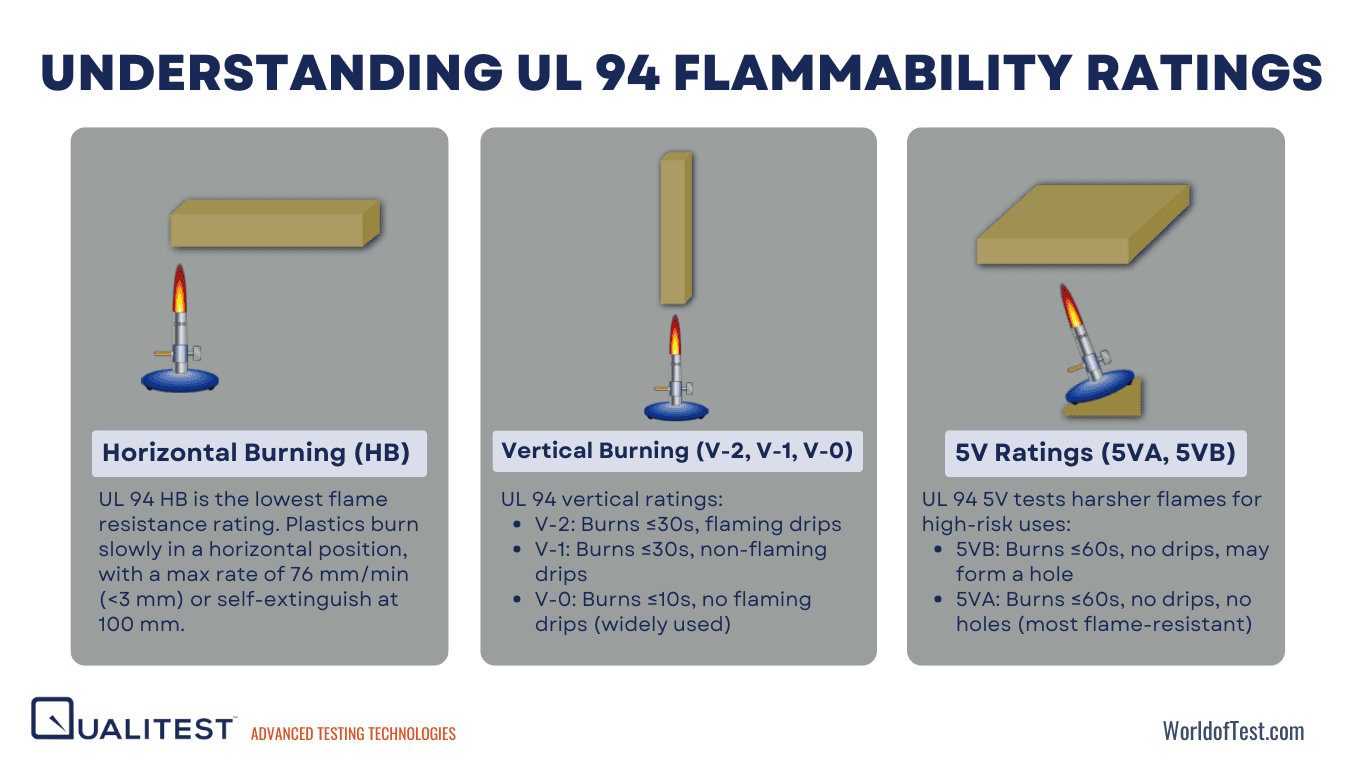
1. Horizontal Burning (HB) – The Baseline Test
This is the entry-level flammability rating, determined by watching the slow-moving burn rate of a piece of plastic lying completely flat. Materials with an HB rating are generally placed in extremely low-risk spots far away from potential electrical sparks or high-heat sources.
Think about a basic decorative pen holder sitting quietly on an office desk or the purely cosmetic outer trim on a piece of office furniture. Those are the perfect candidates for an HB rating.
2. Vertical Burning Tests (V-2, V-1, V-0) – The More Demanding Standards
Standing the piece of material straight up makes the highly scrutinized test substantially harder to pass. The ratings here are separated by how long the fire lasts after you take the flame away and whether the material drips little dangerous balls of fire.
- V-2: The burning stops quickly, but little flaming drips are acceptable. Picture the outer plastic shell of a standard drip coffee maker. It needs to stop burning, but a few drips hitting the counter might be allowed. Notably, V-2 allows flaming drips that may ignite cotton placed below the sample.
- V-1: The burning also stops quickly, but absolutely no flaming drips are allowed at all. Consider the firmly attached internal brackets holding a computer fan securely in place. Those need a higher standard to prevent dropping fire onto a sensitive motherboard.
- V-0: This is the highest vertical rating. Materials rated V-0 generally exhibit better self-extinguishing properties and lower heat release rates compared to lower-rated materials. Look at the heavy-duty power brick charging your laptop. That dense black casing is almost certainly a V-0 plastic. We have observed that V-0 is quickly becoming the expected baseline for high-value electronics as top-tier brands constantly try to outdo each other on total consumer safety.
3. 5V Ratings (5VA, 5VB) – The Highest Level of Flame Resistance
The 5V tests are heavily reserved for materials placed in critical, extremely dangerous spots.
They use a surprisingly intense flame that is roughly five times hotter and vastly more aggressive than the one used in the vertical tests. The primary difference between 5VA and 5VB comes down to whether the material can handle this intensely burning flame without a hole burning straight through it.
Think about a heavy-duty industrial electrical junction box exposed to the elements. That thick housing needs a 5VA rating to ensure an internal spark never breaches the solid outer wall.
4. Tests for Highly Specific Materials
There are also some very specific ratings for low-density foams (HF ratings) and incredibly thin flexible films (VTM ratings) that just can’t be accurately checked with the standard rigidly upright testing procedures. For those strangely shaped puffy materials, a specialized piece of gear like our Vertical Burning Test Apparatus for Rigid Foam Plastics handles the job perfectly.
Key Industrial Applications for UL 94 Rated Materials
Different industries enforce very specific UL 94 ratings based on their own highly researched risk levels and strict government regulations. We supply engineered equipment that directly matches the distinct testing needs of these specific sectors.
1. Electronics & Electrical Components
The plastics inside laptops, computer servers, and heavy-duty power supplies almost always need to meet V-0 or V-1 to stop an electrical short from turning into a full-blown fire. You see this heavily with the tough polycarbonate shells wrapping tightly around your home Wi-Fi router or when running high-voltage cords through a Vertical Flame Tester for Single Cable (QualiFlame™-VFTSC) to prove the internal copper wires won't act like a fast-burning fuse.
2. Automotive Parts
A passenger car's interior contains a truly massive amount of plastic. We see a very clear trend right now where car makers are loudly asking for much higher-rated materials, such as heavy-duty nylon brackets holding electric vehicle battery cells tightly together. Adding huge batteries to vehicles introduces new dangerous heat management problems.
Checking these specific dashboards and seating cushions properly usually involves securing them firmly inside a Flammability Tester for Automotive Materials and Interior (QualiFMVSS™302).
3. Appliances & Consumer Products
Everyday household appliances use thick plastic parts sitting right next to glowing heating elements. The flame-retardant polypropylene pieces placed directly beneath a dishwasher's heating coil are a prime example, making V-2 to V-0 ratings a total necessity to keep family homes safe.
4. Building & Construction
While the massively thick main structural beams follow completely different building codes, the internal pieces like protective PVC conduit piping covering high-voltage lines and wiring jackets are frequently checked against UL 94 standards. Meanwhile, the extremely thick heavy-duty structural panels might get thrown right into a massive Non-combustibility Test Furnace.
5. Aerospace & Aviation
The heavily reinforced plastics used inside an airplane cabin or the tightly packed cockpit panels have to survive incredibly strict fire checks. A fast-moving fire at thirty thousand feet is a nightmare scenario, so V-0 or highly specific thin-material ratings are practically standard operating procedure here.
This includes the lightweight, fire-resistant PEEK plastics used for folding passenger tray tables.
6. Medical Equipment & Healthcare Devices
Those heavily constructed plastic shells protecting expensive MRI machines, glowing patient monitors, and automated hospital beds must completely resist catching fire. The thick impact-resistant polyurethane casings protecting life-saving defibrillators are a prime example since they are packed tightly with high-voltage wiring.
7. Telecommunications & Data Centers
Massive server farms generate an unbelievable amount of heat all day long. The heavily ventilated plastic server racks, massive flame-resistant cable management trays, and highly critical network boxes need the absolute highest level of flame resistance to stop a localized short circuit from taking down an entire regional facility.
UL 94 vs. ASTM Standards
We see people getting twisted in knots over these standards constantly, so let’s set the record straight once and for all.
ASTM D635 vs. UL 94
We’re going to call it—these two are basically twins separated at birth. ASTM D635 is effectively the technical equivalent of the UL 94 HB (Horizontal Burn) test. They both involve laying the plastic sample flat and burning it to see how fast the flame travels. If your lab is set up for one, a solid UL 94 Flammability Chamber – Horizontal Vertical Flame Chamber should handle the other with absolutely zero drama.
UL 94 vs. ASTM E84
Don’t be that guy who mixes these up. Compared to ASTM standards, which cover a broader range of fire resistance tests including building materials (e.g., ASTM E119 for fire resistance of timber) and ASTM E84 for surface burning, UL 94 specifically focuses on the flammability of plastics and their tendency to extinguish or propagate flames under controlled conditions.
ASTM standards often involve full-scale or assembly-level fire resistance testing. Conversely, UL 94 is a small-scale material test primarily used for product safety certification in electrical and consumer goods. You can’t test a wall panel in a small box; you need a beast like the Steiner Tunnel Test Furnace for Optical Fibre Cable UL 910. They are different beasts for different jobs.
The UL 94 Standard Testing Procedure
Getting the exact same trustworthy results every single time means following the highly detailed testing instructions to the absolute letter. We're going to call it—skipping steps in the lab is a guaranteed recipe for a disastrous product recall. To get that satisfying green checkmark of approval, the heavily monitored testing procedure relies on a specific sequence:
- The Required Chill Phase: You cannot just toss a piece of freshly made plastic right into the fire. The procedure starts with letting the carefully cut plastic samples sit quietly in a temperature-controlled room for a set number of hours. Every inch of the material needs to settle and acclimate to a stable environment.
- The Total Lockdown: Next, each prepped sample gets clamped tightly inside a fully sealed box that aggressively blocks all pesky air drafts. There’s not a trace of moving air anywhere near the testing zone. All you closet lab perfectionists know exactly what we’re talking about. A completely draft-free box is non-negotiable!
- The Precise Flame Application: A checked Bunsen burner touches a fiercely burning flame to the plastic for a specific amount of time. The heat intensity is spot on—strong but not overpowering—so the material gets a fair trial.
- The Intense Observation: Highly trained technicians then rapidly click their stopwatches to time the after-flame. They watch closely to see if the plastic holds up and check if any melting drops manage to set a fluffy cotton ball on fire sitting directly down below.
Why Your Perfectly Good Material Might Fail a UL 94 Test
Here is the brutal truth: sometimes the plastic is fine, but the test setup is garbage. Research shows that UL 94 classifications can sometimes be inconsistent with actual inflammability properties due to factors like ignition time variability and melt dripping behavior influencing results. Understanding these nuances helps in designing polymer formulations that meet desired UL 94 ratings for safer applications.
- The Sneaky Draft: If your testing chamber isn’t perfectly sealed, a tiny invisible draft feeds oxygen to the fire. Suddenly, your flame is hotter than it should be, and your plastic burns longer than ten seconds. Fail.
- The Gas Mix: If your methane gas pressure fluctuates even a tiny bit, the flame profile changes. A cheap regulator can ruin an entire batch of tests.
- The "Guesstimate" Timing: Trying to pull the burner away manually at exactly ten seconds? Good luck. Human reflexes aren't that consistent. You need automated arms to do it precisely.
This is exactly why investing in a genuinely professional rig, like the deeply reliable UL 94 Flammability Chamber – Horizontal Vertical Flame Chamber, is so important. You need a constructed piece of sealed equipment with accurate gas controls and automated timing systems.
Choosing the Right Fire & Flammability Testing Equipment
When it's finally time to upgrade your busy lab, you need a precise machine that is accurate, built like a tank, and strictly follows the rules. When picking out a brand-new testing chamber, we strongly suggest you look for the following vital features:
- Capability Across Multiple Rulebooks: The most useful chambers don't just narrowly do UL 94; they can handle similar tests from international groups like ASTM and ISO, giving your lab a whole lot more flexibility.
- Automation and Safety Smarts: Look for advanced features like automated burner arms and a protective remote-controlled exhaust fan. We're going to call it—letting the machine handle the precise movements is an absolute necessity for a modern lab. It takes human shaky hands entirely out of the equation and makes your results way more consistent.
- Built-in Checking Tools: The equipment really needs to fully support or come with a burner calibration kit to make absolutely certain your flame is exactly right on every single test you run.
Qualitest proudly offers a complete engineered lineup of fire and flammability testing equipment to fully satisfy the exact specifications of UL, ASTM, ISO, and other global safety groups.
Ensure Global Compliance with Qualitest
In the competitive materials testing business, being totally accurate is everything. The final grade on a strictly run UL 94 test is what ultimately gets your product approved for the store shelves.
At Qualitest, we view ourselves as deeply invested partners in your success rather than just folks selling heavy metal boxes of equipment. We are a trusted provider for massive Fortune 500 companies, proudly delivering top-tier testing instruments with an unbeatable best-price guarantee and reliable global shipping. Whether you are building a brand-new quality lab from scratch or finally replacing that old dusty gear, our experts are right here to help you put together the perfect testing setup.
Ready to upgrade your flammability testing capabilities? Explore our extensive Fire and Flammability Testing Equipment or get in touch with our team of experts to grab a customized quote.
References
- Hong, S., Yang, J., Ahn, S., Mun, Y., & Lee, G. (2004). Flame retardant performance of various UL94 classified materials exposed to external ignition sources. Fire and Materials, 28.
- Schreiber, H. (1993). Vertical burning tests UL 94-V and IEC 249–1 (4.3.4) theoretical considerations and experimental results. Macromolecular Symposia, 74, 349-357.
- Seah, D., & Dasari, A. (2022). Understanding the influence of melt dripping on UL94 test response in a PA11 system. Polymer Testing.
- White, R. (2015). Analytical Methods for Determining Fire Resistance of Timber Members. 1979-2011.
