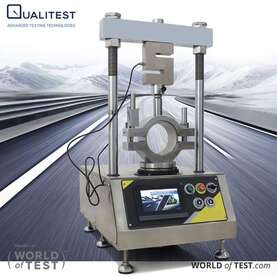
Guide expert des méthodes et équipements d'essai de l'asphalte
Vous en avez assez des dégradations prématurées de la chaussée et des réparations coûteuses ? Garantir la longévité des revêtements commence par des tests précis en laboratoire.
Ce guide vous présente les méthodes essentielles, les normes internationales et les équipements de test d'asphalte nécessaires à la construction de routes qui restent solides pendant des décennies.
Points clés à retenir
- Les tests sont absolument nécessaires : Soumettre votre mélange à une série de contrôles rigoureux avant de le couler permet d'éviter des catastrophes incroyablement coûteuses, comme les fissures de gel et les ornières fondues, qui pourraient ruiner complètement votre projet d'infrastructure.
- Les tests en laboratoire reproduisent parfaitement les conditions en extérieur : En utilisant des équipements hautement spécialisés comme le QualiDSR™ et QualiBBR™ 1 permet de recréer avec précision des journées d'été caniculaires et des nuits glaciales afin de prédire exactement comment l'asphalte réagira aux contraintes.
- L'inspection du chantier est totalement indolore : Les outils de terrain modernes comme le QualiADG™ non nucléaire permettent de vérifier rapidement l'intégrité structurelle du revêtement fraîchement posé sans avoir à démolir complètement la route.
- Le respect des règles établies est absolument non négociable : Vous devez absolument suivre les directives extrêmement strictes des normes ASTM, AASHTO et EN pour vous assurer que vos matériaux obtiennent l'approbation officielle.
- Les équipements intelligents permettent de corriger les erreurs humaines : La modernisation de vos installations avec des écrans tactiles haute précision à microcontrôleur élimine complètement les heures fastidieuses de saisie de données et assure un fonctionnement optimal de votre laboratoire.
Importance du contrôle de la qualité
Ces épaisses couches de revêtement routier subissent chaque jour des agressions incessantes et massives. Entre les semi-remorques gigantesques et lourdement chargées qui martèlent la surface et le soleil brûlant qui la dessèche et la rend dangereusement cassante, la structure même d'une autoroute est constamment mise à rude épreuve.
At QualitestNous sommes convaincus que soumettre vos échantillons à des tests rigoureux en laboratoire est la seule façon d'avoir l'esprit tranquille. Sans ces contrôles obligatoires, le liant noir collant perd toute son adhérence, les roches se désagrègent en poussière et toute la surface se dégrade beaucoup trop vite.
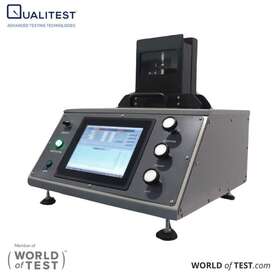
Des appareils de pointe, comme le rhéomètre à cisaillement dynamique QualiDSR™, permettent aux ingénieurs de reproduire avec une précision remarquable l'impact d'un trafic dense et de conditions météorologiques extrêmes sur la chaussée. Cet outil analyse spécifiquement les propriétés visqueuses et non réversibles du bitume, ainsi que ses caractéristiques élastiques et rebondissantes, révélant ainsi comment le mélange se comportera : conservera-t-il sa souplesse ou se rompra-t-il sous l'effet de conditions difficiles ?
Applications du monde réel
Les essais en laboratoire ne servent pas qu'à faire bonne figure. Ils sont essentiels pour éviter que les routes ne s'effondrent. D'après notre expérience sur le terrain, l'utilisation d'outils adaptés permet de prévenir des catastrophes extrêmement coûteuses avant même qu'elles ne surviennent.
Prévention des fissures thermiques
Imaginez un immense chantier d'infrastructure où l'hiver est si rigoureux que le bitume craque comme une brindille sèche. Lorsque les températures chutent complètement, l'asphalte se rétracte et devient extrêmement cassant, engendrant une multitude de réparations hors de prix.
Nous sommes absolument convaincus de l'intérêt d'utiliser un rhéomètre à flexion QualiBBR™ 1. En simulant les chutes de température brutales dues au gel en laboratoire, cet appareil mesure avec précision la rigidité en fluage par flexion des liants bitumineux à des températures proches de zéro. Les recherches confirment que la maîtrise de la rhéologie et de la résistance à la fatigue des liants est essentielle pour prévenir l'apparition de fissures.
Évaluation des dommages causés par l'humidité (décapage)
Dans les zones côtières humides et pluvieuses, l'eau peut s'infiltrer et décoller le bitume directement des rochers. Ce phénomène, appelé « décapage » par les ingénieurs, est un véritable cauchemar qui provoque la dégradation complète des routes. Dans ces zones gorgées d'eau, nous recommandons vivement le test de résistance à la traction (TSR).
En comparant un échantillon parfaitement sec à un échantillon ayant été immergé dans un bain-marie à température précise, les laboratoires peuvent déterminer s'ils ont besoin d'additifs chimiques spécifiques pour assurer une adhésion optimale. Les protocoles de conditionnement avancés, tels que les cycles de congélation-décongélation, permettent d'identifier avec une grande précision ces risques.
Méthodes d'essai de l'asphalte
Essais basés sur les matériaux
Il s'agit entièrement d'examiner les éléments constitutifs fondamentaux, la substance noire merveilleusement collante et les pierres massives et solides, afin de s'assurer absolument qu'il ne s'agit pas de déchets totalement inutiles.
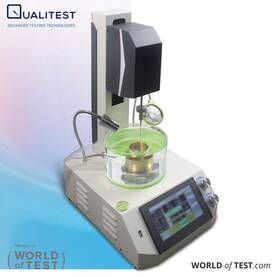
- Test de pénétration du bitume : Cela permet de vérifier précisément la rigidité ou la souplesse du classeur. Vous utilisez un Pénétromètre automatique – QualiPen™ 1000 Auto Pour permettre à une aiguille minuscule et très précise de pénétrer directement dans un échantillon. Connaître cette mesure exacte vous évite de déposer accidentellement une surface qui fond et se transforme en une masse collante par une chaude après-midi d'été.
- Tests de craquage : Les laboratoires modernes s'intéressent désormais à l'IDEAL-CT, un système qui utilise des éprouvettes cylindriques et un équipement de traction indirecte standard. C'est la solution idéale pour détecter précocement les défauts de formulation des mélanges. En simulant la contrainte de traction à l'origine de ces fractures disgracieuses, il est possible d'ajuster facilement la formulation avant même l'arrivée des engins lourds sur le chantier.
- Valeur totale de concassage (ACV) : En gros, vous essayez de réduire les rochers en miettes pour tester leur résistance. Si les pierres de base cèdent sous le poids d'une chargeuse, la solidité de la route est complètement compromise.
Article connexe : Guide de conception des mélanges d’asphalte : Méthodes Marshall et Superpave
Tests de performance environnementale
Ces tests visent entièrement à observer comment le mélange résiste aux caprices exceptionnelles de la nature.
- Rhéomètre à cisaillement dynamique (DSR) : Grâce au QualiDSR™, on analyse l'élasticité et la capacité de reprise des liants, qu'ils soient anciens ou neufs. Cette analyse est essentielle pour les contrôles de récupération après fluage sous contraintes multiples (MSCR). Elle fournit les données précises nécessaires à la conception d'une surface qui ne se déforme ni ne se gondole sous un trafic commercial intense.
- Suivi des roues à Hambourg : Pour prouver que le mix ne sera pas totalement groovy, Dispositif de suivi de roue Hamburg Wheel Tracker - QualiHWT™ 340 Ce test évalue la durabilité à long terme et la résistance à l'orniérage sous un trafic simulé dans un bain chauffé. Il garantit avec une précision remarquable que votre autoroute fraîchement asphaltée ne se transformera pas en un réseau de tranchées dangereuses et remplies d'eau après de fortes pluies.
- Fluage à basse température : Le QualiBBR™ 1 est indispensable dans les régions enneigées. Il mesure la résistance du liant à la fissuration lorsque les températures chutent. Grâce à ces résultats précis, vous pouvez construire en toute confiance des routes d'hiver qui restent parfaitement intactes malgré un gel rigoureux.
Essais de chaussées ciblés
Parfois, il suffit de savoir comment le mélange réagit à la pression réelle d'un pneu en rotation.
- Compactage giratoire Superpave : Le compacteur giratoire - QualiGyra™ T312 Cette machine incroyablement intelligente malaxe le mélange avec une précision remarquable, permettant de prédire avec exactitude la tenue du revêtement dans le temps. Elle imite à la perfection le pétrissage intensif des véhicules, offrant ainsi une image impeccable de la structure interne du matériau.
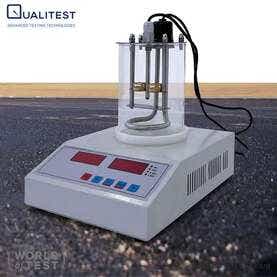
- Test du point de ramollissement : Utilisation de l'année Testeur automatique de point de ramollissement – Appareil à billes et anneauxVous déterminez ainsi le moment précis où le liant passe complètement de l'état solide à un liquide parfaitement visqueux. Maîtriser cette température exacte vous évite le cauchemar embarrassant de l'asphalte frais collé aux pneus des voitures qui passent.
Article connexe : Qu’est-ce qu’un compacteur giratoire ? Guide technique et des normes
Essais de mélange durable (RAP)
Utiliser des matériaux routiers usagés dans les nouveaux enrobés est une excellente initiative pour préserver l'environnement. Cependant, il faut être extrêmement prudent. On utilise un extracteur centrifuge d'asphalte QualiACE™ T164 pour éliminer complètement l'ancien liant, ou un four d'incinération d'asphalte QualiACIO™ pour le brûler.
C'est le seul moyen de garantir que le mélange recyclé soit aussi performant que le matériau neuf. La vérification de la teneur en liant restant et de la qualité des granulats assure que votre revêtement écologique conserve une structure irréprochable et une sécurité optimale pour les automobilistes au quotidien.
Essais sur le terrain et essais non destructifs
Construire la route ne représente que la moitié du travail. Il faut vérifier son travail sans démolir le revêtement neuf.
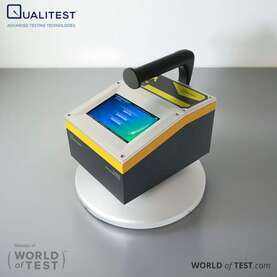
- Jauges de densité : Nous vous recommandons d'utiliser le densimètre d'asphalte non nucléaire QualiADG™. Les densimètres non nucléaires présentent un avantage considérable pour le contrôle de la densité in situ, sans les inconvénients liés aux matériaux radioactifs. Cet outil intelligent vous fournit des mesures de compactage instantanées et très précises, permettant ainsi à votre équipe d'effectuer des ajustements de compactage immédiatement sur le chantier.
- Radar pénétrant dans le sol (GPR): Cet équipement de haute technologie vérifie l'épaisseur et la densité des couches sans creuser le moindre trou. En faisant rebondir des ondes électromagnétiques à travers l'asphalte, on obtient un profil parfaitement clair et continu du sous-sol, ce qui permet de repérer facilement les zones fragiles cachées avant qu'elles ne se transforment en gouffres.
- Essais de déflexion : Les déflectomètres à poids lourd (HWD) sont parfaitement adaptés à l'évaluation de la capacité structurelle des routes finies. Ces machines imposantes laissent tomber un poids lourd sur la chaussée afin de simuler parfaitement l'impact violent d'un camion commercial chargé, démontrant ainsi la résistance réelle de la surface.
Normes d'essais mondiales
Il est absolument impossible d'improviser. Vous devez impérativement suivre les règles extrêmement strictes sur lesquelles tout le monde s'accorde.
- ASTM International : Ce sont les règles classiques, extrêmement volumineuses, utilisées littéralement partout pour les tests standard de Marshall ou de Pénétration.
- Directives de l'AASHTO : Ce sont les ouvrages de référence incontournables pour les services des routes les plus rigoureux. Ils traitent exclusivement des aspects absolument essentiels des infrastructures publiques.
- Normes européennes (EN) : Le respect de la série de normes EN 12697 est la loi absolue sur les marchés européens.
- Certifications ISO : Ces mesures permettent de garantir une cohérence parfaite quel que soit le pays où vous vous trouvez.
Matrice des équipements essentiels
Pour vous faciliter la vie, malgré votre emploi du temps chargé, nous avons dressé cette liste des outils remarquablement précis dont vous avez réellement besoin pour bien faire le travail du premier coup.
| Type de test | Règlement applicable | L'outil idéal pour la tâche |
|---|---|---|
| Stabilité et débit | ASTM D6927 | Testeur de stabilité Marshall |
| Craquage (IDEAL-CT) | ASTM D8225 | Cadre de résistance à la traction indirecte |
| Compression du trafic | AASHTO T312 | QualiGyra™ T312 |
| Élasticité du liant | AASHTO T315 | QualiDSR™ |
| Dureté du liant | ASTM D5 | QualiPen™ 1000 Auto |
| Résistance à l'orniérage | AASHTO T324 | QualiHWT™ 340 |
Guide de sélection d'équipement
Description du projet
Que construisez-vous ? Un circuit automobile à très grande vitesse ou une autoroute tentaculaire nécessitent un équipement Superpave de pointe comme le QualiGyra™ T312. Un petit parking ? Le testeur de stabilité Marshall classique pourrait suffire.
Conditions environnementales
Quel temps fait-il ? Si vous vous trouvez dans un endroit aux conditions climatiques extrêmes, qu’il fasse une chaleur torride ou un froid glacial, ne lésinez pas sur le QualiBBR™ 1 ni sur les outils d’une précision remarquable de l’appareil Ring & Ball.
Automatisation du flux de travail
Nous avons constaté que les meilleurs laboratoires abandonnent de plus en plus les molettes manuelles. En se débarrassant avec enthousiasme des anciens boutons rotatifs et en adoptant des écrans tactiles comme celui du QualiACIO™, les laboratoires réduisent considérablement le temps consacré à la saisie fastidieuse de données et éliminent totalement les erreurs humaines.
Les exigences de conformité
Assurez-vous que vos outils soient faciles à régler et qu'ils répondent parfaitement aux exigences extrêmement strictes de la norme ISO/IEC 17025. Les audits, souvent fastidieux, deviendront alors un jeu d'enfant.
Obtenez des résultats précis avec Qualitest Équipement de test d'asphalte
La construction de routes durables exige précision et respect rigoureux des normes internationales. En choisissant l'équipement de test adapté, vous garantissez l'intégrité structurelle de vos projets.
Si vous êtes prêt à moderniser vos installations, consultez notre catalogue complet d'équipements d'essais d'asphalte pour garantir que votre laboratoire fournisse des résultats constants.
Références (Cliquez pour développer)
- Akentuna, M., et al. (2023). Sensibilité à l'humidité des mélanges d'asphalte : protocoles de conditionnement et d'essai. Dossier de recherche sur les transports.
- Bessa, I., et al. (2019). Résistance à la fatigue des liants bitumineux et corrélation avec le comportement des mélanges bitumineux. Matériaux routiers et conception des chaussées.
- Khanal, M., et al. (2022). Équipement d'essai en laboratoire et sur le terrain pour l'optimisation du revêtement en asphalte. CPRASE.
- Mohammad, L., et al. (2017). Évaluation de divers dispositifs anti-orniérage de roues de Hambourg et de la spécification AASHTO T 324. Matériaux routiers et conception des chaussées.
- Potapov, A., et al. (2021). Essais non destructifs de qualité des chaussées en béton et en béton bitumineux. Journal de physique.
- Rath, P., et al. (2021). Évaluation en laboratoire et sur le terrain d'un asphalte modifié par un procédé à sec prétraité. Dossier de recherche sur les transports.
- Wang, S., et al. (2022). Mesure de la densité des chaussées en asphalte à l'aide de méthodes d'essais non destructives. Construction et matériaux de construction.
- Wood, N., et al. (2024). Évaluation des dispositifs de test de densité d'asphalte non destructifs nucléaires et non nucléaires. Essais et évaluation non destructifs.
- Zhang, R., et al. (2021). Évaluation des corrélations entre les propriétés des matériaux en laboratoire et la fissuration sur le terrain. Construction et matériaux de construction.
- Zhou, F., et al. (2017). Développement d'un test de fissuration IDEAL pour la conception de mélanges d'asphalte et le CQ/AQ. Matériaux routiers et conception des chaussées.