High Performanced Process Temperature Control System – QualiTCS™ HPPT Series Applications
1) Reaction Still
Reaction still systems are widely used across petroleum, chemical, rubber, pesticide, dye, pharmaceutical, and food processing, as well as R&D labs. Common workflows include hydrolysis, neutralization, crystallization, distillation, evaporation, storage, hydrogenation, polymerization, condensation, and heated mixing.
Stable temperature control supports faster heat-up and cool-down, while enabling real-time recording of reaction temperature during the full process.
2) Microchannel Reactor
Microchannel reactors support multiple reaction types, including fast reactions with strong heat release, liquid-phase reactions, gas–liquid reactions, and absorption processes. Typical chemistry routes include nitration, sulfonation, oxidation, peroxidation, alkylation, amination, and photochemical or gasification-related reactions (process-dependent).
A wide operating temperature range and precise, intelligent control help maintain consistent conditions with a single heat-transfer fluid, reducing the need to change thermal media during development work and fine chemical synthesis.
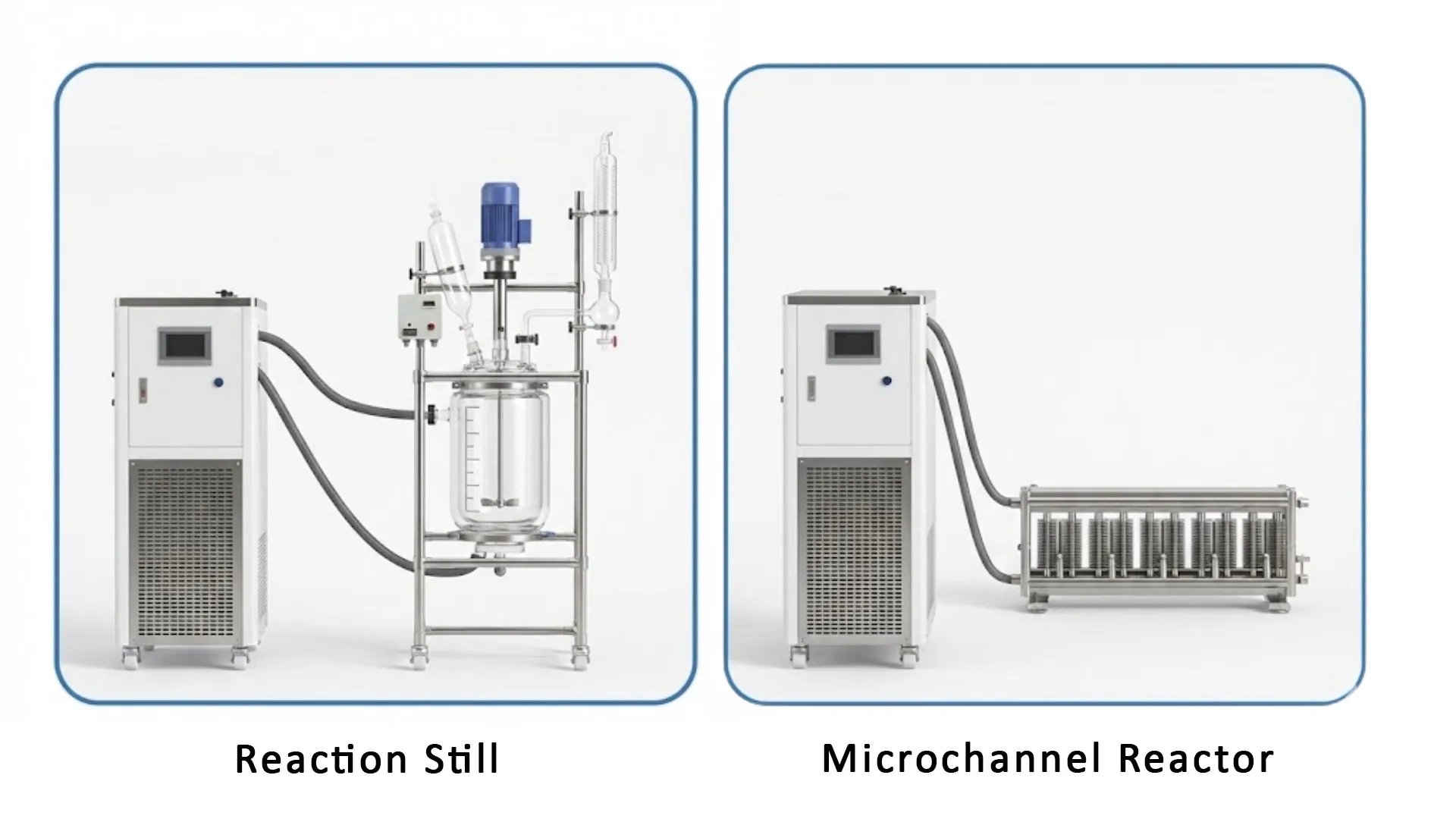
This High Performanced Process Temperature Control System (-60°C to 200°C) – QualiTCS™ HPPT Series also can be use to:
- Reactor and jacketed vessel temperature control: Maintain consistent product conditions in jacketed reactors where heat-up, hold, and cool-down cycles affect yield and viscosity. The system can control either process material temperature (with an external probe) or thermal-fluid outlet temperature, depending on your control strategy.
- Microchannel and continuous-flow skids: Support precise thermal management in microreactors where residence time is short and temperature drift shows up immediately in conversion. High circulation flow options help stabilize inlet conditions to compact heat exchangers.
- Distillation and condensation loops: Hold condenser, receiver, or column jacket temperatures at setpoints to improve separation repeatability. Temperature trend display and logging help verify steady-state behavior during long runs.
- Extraction and crystallization processes: Control cooling profiles that drive nucleation and crystal growth. Programmable multi-step recipes help standardize the same temperature curve across batches and operators.
- Automotive, pharma, petrochemical, electronics, and aerospace test setups: Run controlled thermal cycles for component tests, material studies, and process validation work. The series is used across multiple industries that require controlled heating and cooling around process equipment.
