Theory and Method
Hydraulic load testing relies on Pascal's principle: pressure applied to a confined fluid transmits equally in all directions. The hand pump forces oil through the hose into the cylinder, where the pressure acts on the piston's effective area to generate force. Because force equals pressure multiplied by area, a modest hand effort at the pump produces tens or hundreds of kilonewtons at the ram. The digital gauge reads system pressure, which converts directly to the axial load applied to the anchor under test.
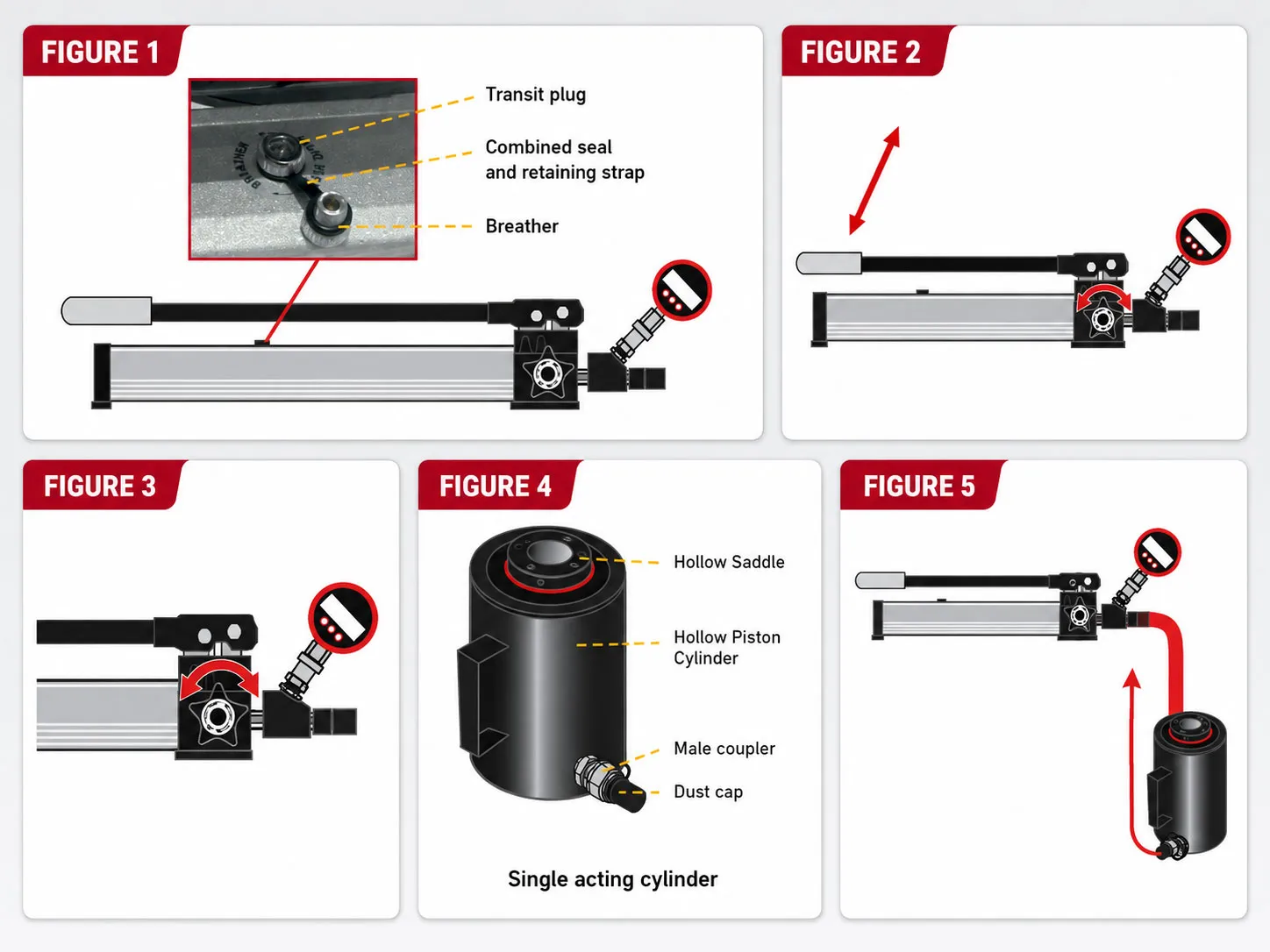
The hollow ram design routes the anchor rod or cable through a bore running the length of the piston. A single-acting hollow ram cylinder carries a hollow saddle on top of the hollow piston, with a male coupler and dust cap at the hydraulic port (Fig 4). An operator threads the fastener through the cylinder, secures it above the ram with a nut or grip, and seats the cylinder base against the substrate or a load-spreading bridge. As the piston extends, it pushes against the surface while drawing the rod upward, which places the anchor in pure axial tension. This in-line loading reproduces the service condition the fixing must resist.
The cylinder operates single-acting, so hydraulic pressure drives the piston outward while an external load returns it on release. The two-speed pump moves the piston quickly under low pressure during the approach, then shifts to high pressure for the final load build. The load-holding valve keeps the ram in position without drifting once the target load is reached. This combination lets one technician build, hold, and release a precise test load by hand.
Setup and Operation
Before testing, position the pump horizontally on a flat surface and check the oil level. Remove the transit plug from the top of the tank and fit the breather in its place, which frees the full oil volume for the test (Fig 1). Top up to roughly 10 mm below the tank top with ISO VG 32 or ISO VG 46 mineral hydraulic oil, keeping the cylinder fully retracted while filling.
Bleed the system before the first test. Connect the cylinder to the pump, place it below the pump with its pressure ports uppermost, open the bleed screw, and stroke the cylinder three to four times over its full travel so trapped air returns to the reservoir (Fig 5). When a small cylinder runs on long hoses, bleed with a shorter hose first if the hose volume exceeds the cylinder volume.
To advance the ram, turn the release knob clockwise and work the pump handle (Fig 2). The pump switches automatically from high-flow low-pressure to low-flow high-pressure as resistance rises, and the valve holds the load so the ram does not retract on its own. To release the load, turn the release knob anti-clockwise slowly, no more than one to two turns, so the piston retracts under control (Fig 3). Fully retract the piston after each test, fit dust caps when disconnecting hoses, and refit the transit plug before transport.