Why Choose the IRHD Micro Hardness Tester?
1. Overview Micro-IRHD Hardness tester with laser centring device:
This device enables the automatic measurement of micro  IRHD hardness tester for a test piece placed on the sample holder.
- It comes equipped with a laser centering device and a motor-controlled sample holder to accurately position the part for measurement.
- The sample holder moves the test piece beneath the laser centering tool and positions the optimal test point under the micro IRHD testing unit.
- The positioning and hardness measurement are done automatically, eliminating the need for operator intervention.
This instrument is perfect for obtaining fast and consistent results, especially when dealing with small parts that are challenging to center manually.
1.2. Use of the Micro-IRHD Hardness tester with laser centring device:
The sliding sample-holding mechanism of this instrument allows testing of a single part, requiring manual replacement of the part after each test.
To conduct the test, follow these steps:
- Position the part to be tested on the test line of the motor-controlled sample holder.
- Enter the product identification.
- Press the start button.
- Wait for the sample holder to return to the starting position after the test is completed.
- Remove the tested part and place the next one to be tested on the sample holder.
- The obtained results can be printed and saved for record keeping.
2. State-of-the-Art Technology for Micro-IRHD Hardness tester with laser centring device and rotating sample holder:
The IRHD Micro Hardness Tester with a laser centering system represents the most advanced solution for automatically measuring the hardness of small pieces.
To conduct the test, you only need to:
- Enter the identification of the pieces to be measured.
- Place the parts on the specimen holder disc.
- Press start.
The specimen holder disc initiates rotation, while the laser centering device precisely locates the testing point. The hardness tester then performs the test at the designated positions.
This positioning and measurement process is repeated automatically for all the pieces placed on the measurement line, eliminating the need for operator intervention.
The measurement results are compared with the preset tolerance limits and automatically saved in the database.
2.1. Applications of the Micro-IRHD Hardness tester with laser centring device and rotating sample holder:
The instrument enables the serial measurement o f Micro-IRHD hardness in O-rings and small parts, eliminating human influence in the sample positioning.
The instrument is particularly beneficial for the following applications:
- Product approval or Quality Control tests that necessitate repeated testing on a statistical basis.
- Mold approval tests.
- Process capability analysis.
- Testing of small parts that are difficult to center manually.
O-rings or small parts with a thickness ranging between 1 and 20 mm can be tested.
Additionally, the laser testing process can be paused to conduct tests with standard samples.
Exclusive Plus
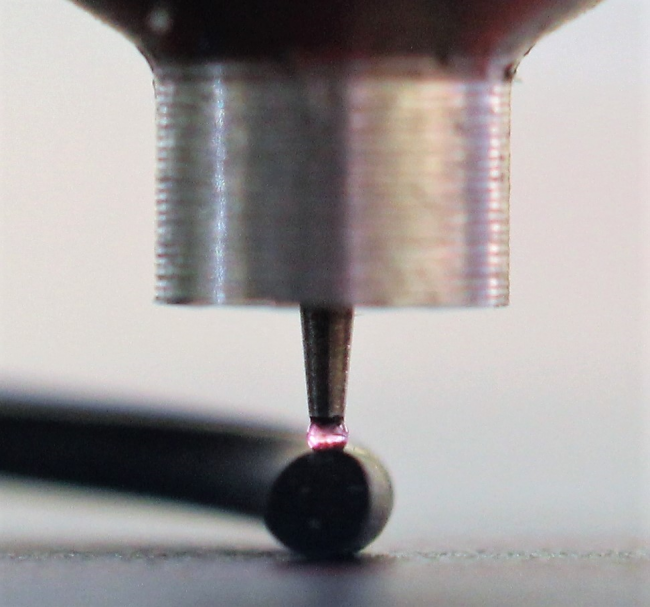
RUBY INDENTOR:
The global manufacturer that utilizes a Ruby ball indenter for Micro-IRHD durometers, guaranteeing:
- Perfect sphericity of the ball.
- Excellent surface finish.
- Minimal ball wear over time.

Accredited CALIBRATION:
The instrument can be provided with an Accredited calibration certificate issued by the calibration laboratory.
TESTS ON NON-SYMMETRIC PIECES:
The software enables scanning of your pieces and defining and storing the appropriate measuring point for each product.

