Theory and Method
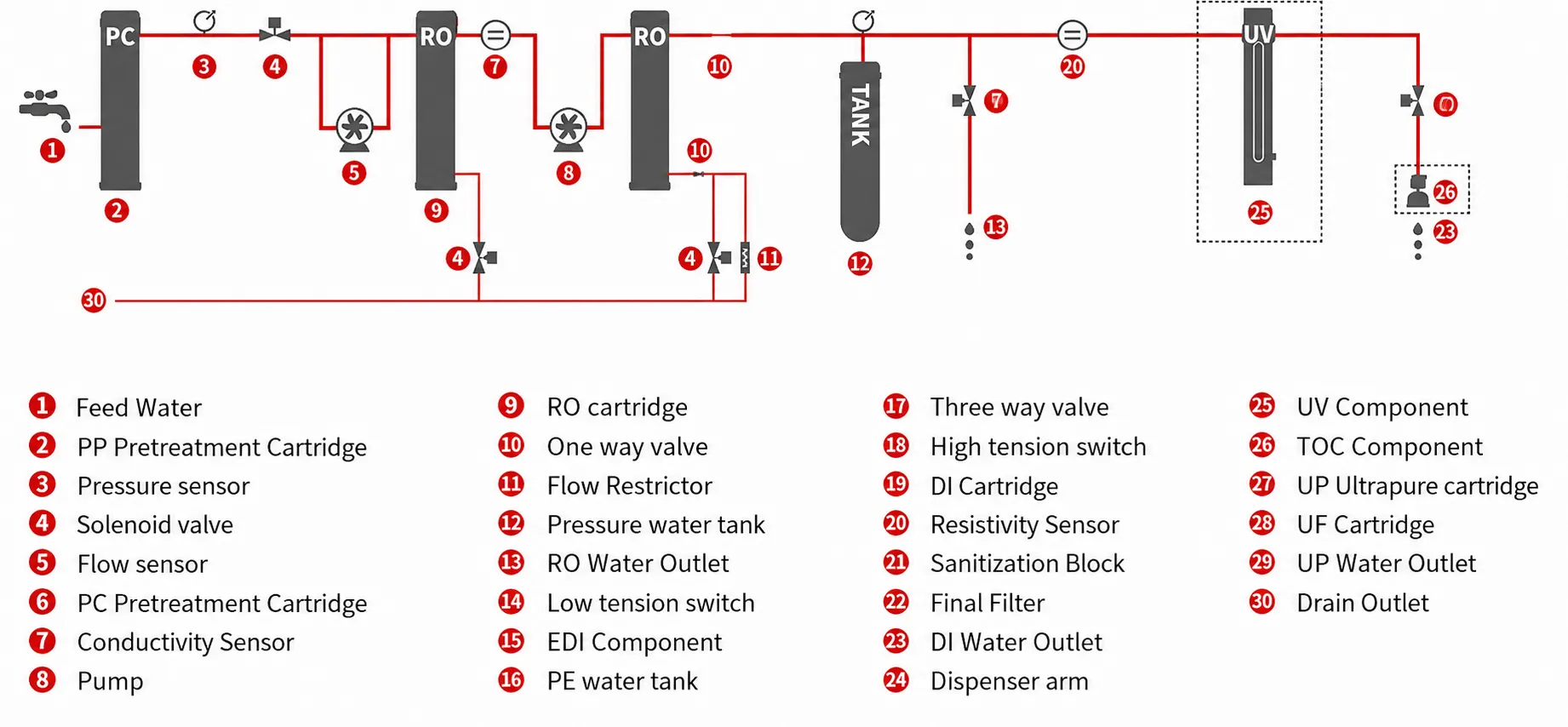
A reverse osmosis membrane separates water from what is dissolved in it by acting as a pressure-driven filter at molecular scale. Water placed under pressure against a dense polyamide film passes through, while dissolved salts, organics above roughly 300 daltons, colloids, and microorganisms cannot. The rejected material leaves continuously as a concentrate stream to drain. That split defines the recovery ratio, and the QualiRWS™ C runs its two membranes at a recovery that keeps salt concentration at the membrane face within safe limits.
Rejection is never total, so engineers describe performance as the fraction of salt that passes rather than the fraction removed. A membrane rejecting 98 percent passes 2 percent. Feeding that permeate to a second membrane multiplies the two passage fractions together, and the residual drops to a small fraction of one percent. That compounding is the reason the QualiRWS™ C holds under 5 µS/cm from feed water as hard as 2,000 µS/cm, a figure a single pass could not reach reliably.
Salt builds up in a thin layer against the membrane face during operation, a condition called concentration polarization that raises local osmotic pressure and seeds scale. The system answers it by flushing the membrane surface on a set schedule at raised crossflow. Ahead of the membranes, a 12-inch composite cartridge combines a 5-micron pleated depth layer with catalytic activated carbon fiber, which traps sediment and strips free chlorine before it can oxidize the polyamide film and destroy rejection for good.