Compression Set Test Fixture
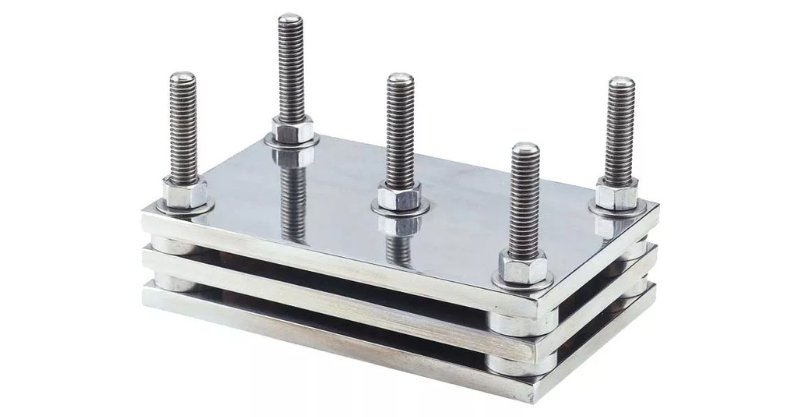
Compression Set Testing of Rubber, Flexible Cellular Materials and other Elastomers: Compression set testing measures the ability of rubber to return to its original thickness after prolonged compressive stresses at a given temperature and deflection. As a rubber material is compressed over time, it loses its ability to return to its original thickness. This loss of resiliency (memory) may reduce the capability of an elastomeric gasket, seal or cushioning pad to perform over a long period of time. The resulting permanent set that a sample may take over time may cause a leak; or in the case of a shock isolation pad, the ability to protect an accidentally dropped unit may be compromised.
Compression set results for a material are expressed as a percentage. The lower the percentage, the better the material resists permanent deformation under a given deflection and temperature range.
Compression set test fixtures are specifically utilized to test the static compression of rubber. Place a standard specimen between parallel flat plates, adjust the screws to secure it, then compress it within a specified range of percentage. Next, place it into the oven at the specified temperature for a certain period of time. Afterward, allow it to cool for 30 minutes before measuring its thickness to calculate the permanent deformation rate.
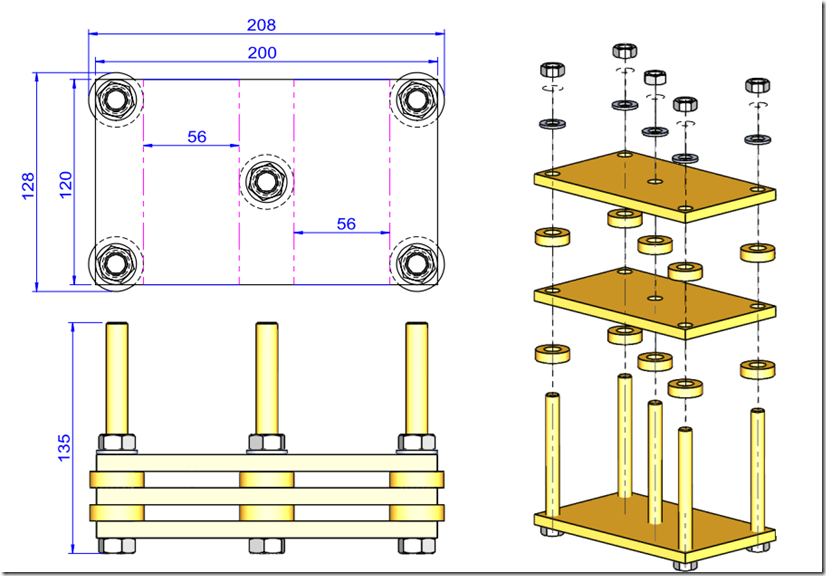
Compression Set Test Fixture — dimensional diagram showing overall frame size (208×128×135 mm), partition plate (200×120 mm), and five-column layout with 56 mm column pitch.
The five-column frame positions the partition plate within an open working area suited to standard rubber specimens (28.68 mm and 12.7 mm diameter) as well as larger finished parts. For O-rings or custom specimens, the governing measurement is the clear span between adjacent columns rather than the plate dimensions — contact our team with your specimen's outer diameter and cross-section to confirm fit.
