Theory and Method
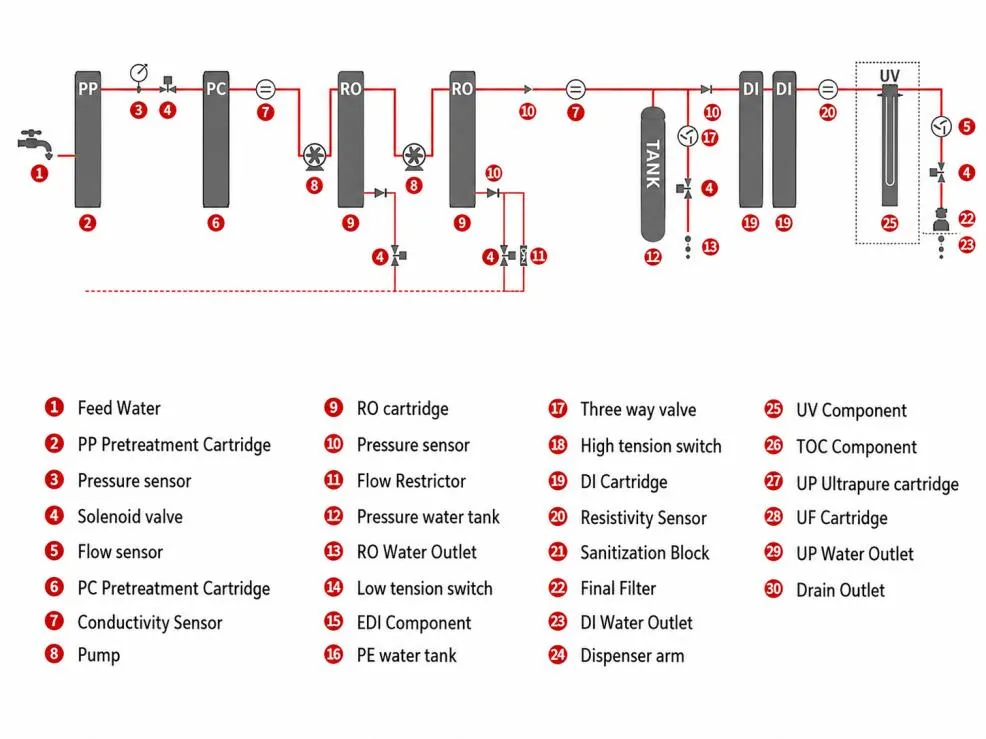
Purification starts with two pretreatment cartridges working in sequence. The first holds a deep-folded polypropylene membrane rated at 5 μm, which strips suspended solids that would otherwise abrade or blind the membrane surface downstream. The second carries catalytic activated carbon fiber at the same rating, adsorbing free chlorine and dissolved organics. Chlorine matters most here, since it oxidizes polyamide membrane chemistry and shortens module life. A pump then drives the conditioned water against the first reverse osmosis membrane.
One membrane pass removes a proportion of the dissolved load rather than a fixed quantity, so hard feed leaves more behind. A second membrane re-applies that rejection to an already cleaned stream, which holds RO output below 5 µS/cm on supply as conductive as 1,500 µS/cm. Soluble ions, organics, microorganisms, and particles drop by up to 99 percent across the pair. Automatic flushing clears salts off the membrane faces on an adjustable schedule, and permeate failing the outlet check goes to drain.
Storage sits between the membrane stack and the polishing cartridges, which is a deliberate choice. Deionized water loses resistivity fastest in a tank, since atmospheric carbon dioxide dissolves into it and forms conductive bicarbonate. Holding RO water instead keeps the buffer stable, and the ion-exchange bed treats it on the way to the outlet, trading hydrogen and hydroxide ions for the remaining cations and anions until resistivity passes 17.5 MΩ·cm. The bacteria and particle build adds a double-layer PES microfilter at the outlet.