Most product failures aren't a great mystery. They typically happen because a small, critical detail was overlooked somewhere in the process. And when your business deals with elastomeric or rubber components, the most commonly overlooked detail is the material's specific firmness.
That number is its durometer, and treating it as a static, unchanging property is a significant business risk.
Many professionals operate as if a rubber component's firmness is fixed from the factory. You test a sample, it passes, and you move on. But here's the critical secret that impacts the bottom line: ambient temperature can cause that hardness value to fluctuate dramatically.
We’re going to outline the dynamic of rubber durometer vs temperature, why it matters to your operational reliability, and how in-house verification is the only way to truly manage your risk.
The Core Science: How Does Temperature Affect Shore A Durometer for Rubber?
The answer to how does temperature affect shore a durometer for rubber lies in the material’s molecular activity. Imagine the rubber is made of countless long, tangled polymer chains. The way these chains interact and move dictates the physical properties of the material.
The Effect of Heat: Softer Material, Lower Durometer
When the temperature rises, these polymer chains absorb energy and their activity increases dramatically.
The bonds between them loosen, allowing the chains to slide past each other more easily. This molecular excitement makes the entire material softer, more pliable, and less resistant to indentation. That gasket that was firm at room temperature might start to exhibit excessive softness in a high-heat environment.
When tested, this results in a noticeable downturn in its Shore A durometer reading.
Related article: Durometer Hardness: Shore A vs Shore D Differences
The Effect of Cold: Harder Material, Higher Durometer
Conversely, when the temperature drops, that molecular energy dissipates.
The chains slow down, contract, and begin to lock up. With reduced movement, the rubber loses its characteristic flexibility and becomes significantly harder and more rigid. This increased stiffness makes it far more susceptible to cracking under stress or impact.
When tested in this state, its Shore A durometer value will climb significantly.
Related article: How to Measure Rubber Hardness: Methods, Tools, and Best Practices
The Impact in a Real-World Scenario
This is not a minor, academic fluctuation; it's a major variable with real-world consequences.
A standard EPDM component that measures a perfect Shore 70 in your quality lab could easily become a soft 65 in a hot engine bay or a rigid 80 on a cold loading dock. For an engineer who specified that part for its precise 70-durometer properties, this variance isn't a minor detail—it’s a direct threat to the product’s performance and integrity.
Related article: Understanding the Shore Hardness Test: Method, Formula & Diagram
The Business Risk of Ignoring Rubber Durometer vs Temperature
Let us provide a more concrete example. A major automotive manufacturer sources thousands of O-rings for a new fuel injector system.
The components pass all quality control checks at their temperate production facility. However, the design team failed to account for the issue of rubber durometer vs temperature in vehicles operating in colder climates.
The first winter hits, and the company is flooded with warranty claims for fuel leaks—a costly PR disaster and a serious safety issue. A root cause analysis reveals that at freezing temperatures, the rubber O-rings hardened, lost their elastic properties, and failed to maintain a proper seal.
We see this as a classic case of a catastrophic failure that was entirely preventable.
Related article: Elevating The Quality of Rubber Samples: Qualitest's Solution for Sika's Testing Needs
That scenario shows why ignoring this fundamental relationship is not a viable business strategy. The consequences are real and they directly impact your operations.
- Complete Product Failure: It’s not just a small leak. A failed seal can cause a cascading failure that damages more expensive systems, leading to costly warranty claims, product recalls, and significant damage to your brand's reputation.
- Reduced Component Service Life: A part that is constantly cycling between hard and soft states ages prematurely. This thermal cycling just beats the life out of the material, leading to more frequent maintenance schedules, higher lifetime ownership costs, and unplanned equipment downtime.
- Decreased Operational Efficiency: Long before a total failure, a component with the wrong hardness will degrade performance. A vibration mount that’s too hard in the cold will transfer excess vibration, causing noise and wear on the entire assembly. It's a slow erosion of quality.
- Serious Safety and Compliance Issues: In the automotive, aerospace, or medical fields, component failure is a direct safety liability. Verifying material stability isn't just good practice; it’s essential for meeting regulatory compliance and ensuring user safety.
Stop Guessing and Start Testing: Picking the Right Verification Tool
Understanding how does temperature affect shore a durometer for rubber is one thing, but that knowledge is useless without the ability to measure your actual components. You have to verify them. This is how you prove that the materials you’re using will perform as expected. Relying solely on a supplier's spec sheet introduces a layer of risk; testing it yourself is about taking ownership of your quality control.
To do this effectively, you need a professional-grade instrument. Using a low-cost, uncalibrated device is worse than not testing at all, as it provides a false sense of security.
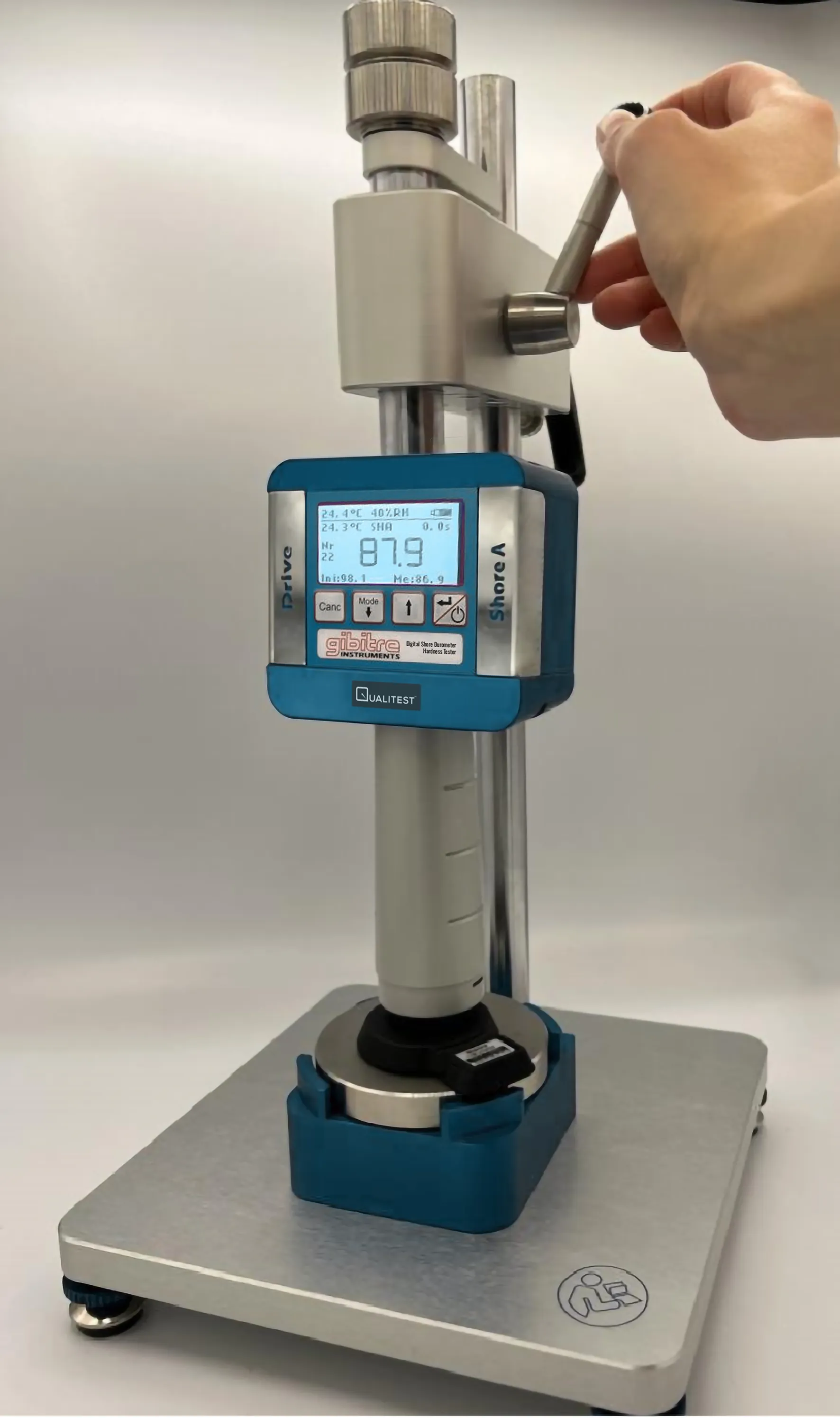
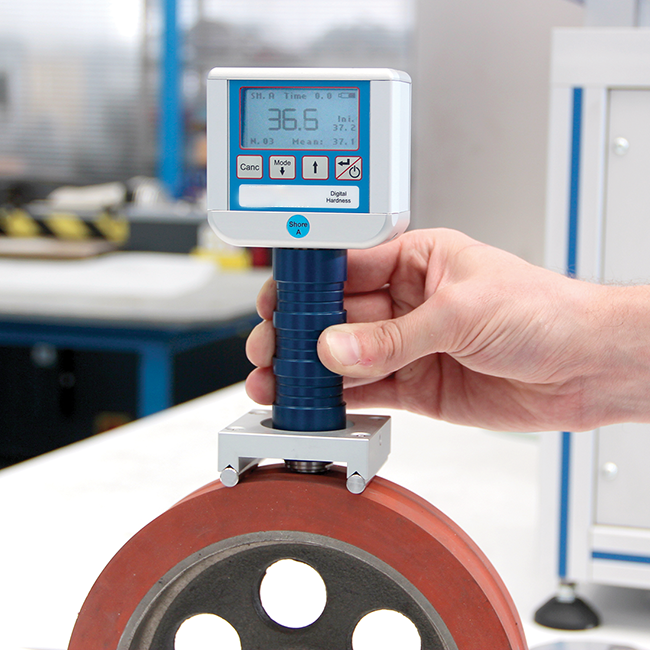
Investing in a real-deal, professional-grade Digital Shore Durometer or an Automatic Hardness Tester is how you get repeatable, reliable, and defensible data. In our experience, any company that is truly serious about producing a quality product relies on these kinds of tools.
Just as you need the right tool for any other job, you need the right tester for your specific material. Thinking you can use one tester for everything is a common oversight. Here’s a straightforward breakdown of the primary tools for the job.
| What It Is | Best For | Key Applications |
|---|
| Digital Shore Durometer | This is the workhorse of the QC lab. A handheld instrument that lets you quickly check the hardness of almost anything, from soft seals to harder plastics. It's efficient and provides a number you can trust for process control. | This tool is ubiquitous. It's used for quality checks on incoming parts, on the production line, and for final inspection of O-rings, tires, and more. |
| Automatic Durometer | This is for high-volume or high-precision applications. It’s a benchtop machine that removes the human variables—operator influence, inconsistent angles—to provide pure, repeatable data for your records. | You see these in serious R&D labs where precision is paramount, and in any facility with stringent, high-volume quality control requirements. |
| Micro Hardness Tester | This is the specialist for measuring very small or thin rubber samples without destroying or deforming them. It uses a different method (IRHD) with a smaller contact point to get a true reading on delicate parts. | This is the essential tool for anyone making small medical parts, miniature seals for electronics, or any other delicate component where standard testing isn't feasible. |
| P&J Plastometer | This is a highly specialized instrument for a specific industrial application: checking the large rubber rollers used in massive paper-making machines. Its methodology is entirely different from a standard durometer. | You will only find this in the paper and printing industry, where the hardness and consistency of those rollers are absolutely critical to production quality. |
Heads up: This is a sample of our solutions. We always recommend a brief consultation to ensure the instrument you choose is a perfect match for your materials and quality standards. A five-minute conversation can prevent a costly purchasing error.
We Provide the Tools You Need to Succeed
Here at Qualitest, we understand this field. We know that reliable products are built on verified materials. Knowing the principles of rubber durometer vs temperature is step one. Having the right tool to measure it accurately is step two.
We supply the high-precision durometers and testers that empower engineers and QC managers to guarantee their materials meet the required specifications.
Our entire lineup of Shore and IRHD hardness testers is engineered to deliver spot-on data without straining your budget. If you're ready to remove the guesswork from your quality process, give us a shout. Our team is here to help you find the exact right tool for your application.
To put it plainly, a material failure can do more than just stop a project in its tracks; it can damage your reputation and your bottom line.
In our experience, many of these failures begin with a simple misunderstanding of material properties. The most common point of confusion we see is the tensile strength vs durometer issue. They sound related, but they measure entirely different characteristics, and the choice between them is a critical decision.
We believe that clarifying this durometer vs tensile strength distinction is the foundation of excellent quality control. This isn't just about dry technical data; it's about producing components that perform correctly in the real world. So here is the definitive guide to help you make the right call.
What is Durometer? The Surface Hardness Side of the Equation
Durometer is the industry-standard number that tells you how hard a material is, specifically how well its surface resists being indented.
The hardness test itself is straightforward: an indenter is pressed into the material, and the depth of the indentation gives you a reading from 0 to 100. A higher value means a harder material.
This property is essential for any application where surface interaction is key, which is a core part of the tensile strength vs durometer consideration. To give you a practical sense of the scale:
- A gel insole might be Shore A 20
- A rubber band is typically Shore A 40
- An automotive tire tread is around Shore A 70
- A shopping cart wheel is harder, around Shore D 50
- A construction hard hat is very rigid, at about Shore D 75
Read more: Durometer Hardness: Shore A vs Shore D Differences
While it's a fantastic method for a quick quality check, we always advise that durometer only gives you part of the story. To get a reliable reading, you need the correct instrument for the material class you're testing. We offer a full range of durometers to cover any application, from portable units to automated systems for absolute consistency.
What is Tensile Strength? Measuring a Material's Core Strength
Tensile strength is a completely different measurement that tells you about a material's fundamental structural integrity. This is where we find out how much of a pulling force a material can withstand before it fractures.
This is where the tensile strength vs durometer debate becomes clearest; one is about the skin, the other is about the bones. The data from this destructive test reveals a material's elasticity, elongation, and overall toughness.
The range of values can be enormous:
- Silicone Rubber: ~10 MPa (1,450 psi)
- Nylon: ~75 MPa (10,800 psi)
- Aluminum: ~250 MPa (36,000 psi)
- Structural Steel: ~400 MPa (58,000 psi)
While the ultimate breaking point is a key specification, we've found that modulus is often a more practical figure. Modulus tells you how much a material will stretch under a normal load. Our tensile testing machines provide you with the full data set, so you get a complete performance profile.
The Decisive Difference: Durometer vs. Tensile Strength
While both properties speak to a material's toughness, they are not interchangeable. Durometer is a non-destructive test of surface hardness, while tensile strength is a destructive test of internal strength.
In our view, the most significant mistake in the durometer vs tensile strength analysis is to assume hardness equals strength. A high durometer reading does not guarantee high tensile strength. This table breaks down the comparison:
| Feature | Durometer | Tensile Strength |
|---|
| What it Measures | Surface hardness; resistance to indentation. | Internal strength; resistance to being pulled apart. |
| Test Method | Non-destructive: An indenter is pressed into the material's surface. | Destructive: A sample is stretched until it breaks. |
| Units of Measurement | A dimensionless scale (e.g., Shore A, Shore D, IRHD). | Force per unit area (e.g., psi, MPa). |
| Property Type | Surface Property | Core Property |
| Primary Application | Assessing resistance to wear and surface deformation. | Assessing structural integrity and ability to bear loads in tension. |
| Failure Indication | Indicates surface durability. | Determines the exact point of material fracture under tension. |
Real-World Applications in the Tensile Strength vs. Durometer Debate
You can see where these properties make a difference in countless products. Getting the specification right is what separates a reliable component from a costly failure.
- For Automotive Tires, the key property is durometer. The entire performance of the tire is a function of getting the hardness right. Tire manufacturers use Shore A Durometers constantly.
- In Medical Tubing, tensile strength and elongation are the primary concerns. The material must be strong enough to handle internal pressure without failing. Our Single-Column Tensile Testers are ideal for this.
- With Gaskets and Seals, durometer is again the focus. A proper seal relies on the material's ability to compress and then exert a sealing force. Digital Durometers provide a fast and accurate way to confirm this.
- For Printing and Industrial Rollers, the critical property is durometer. The hardness of a roller's surface directly controls the quality of the final product.
- In Safety Equipment like harnesses, the single most important metric is tensile strength. For a product designed to save a life, its ability to withstand extreme pulling forces is its entire reason for being. This is a clear case where one side of the durometer vs tensile strength argument is non-negotiable.
- For Conveyor Belts, performance depends on tensile strength and modulus. These components are under constant load and tension, making their internal strength, tested with our Dual-Column Universal Testing Machines, the most important specification.
Selecting the Right Tester: A Durometer vs. Tensile Strength Breakdown
Once you've identified the critical property, you can select the right instrument. The choice in the tensile strength vs durometer dilemma depends entirely on what you need the material to do.
You should select a durometer if:
- Your primary concern is the surface characteristics of a material, such as its resistance to wear or indentation.
- You are working with elastomers or plastics for applications like seals, O-rings, or rollers.
- You need a fast, non-destructive method for quality control checks.
- The physical "feel" or softness of a product is a key quality attribute.
You absolutely need a tensile tester if:
- The structural integrity of the component is the top priority, and failure under a load would be unacceptable.
- The part will be subjected to pulling or stretching as part of its normal function, such as in belts, cables, or straps.
- You need a complete performance profile of a material, including its ultimate breaking point and modulus.
- Your goal is to qualify new materials or perform failure analysis, where comprehensive data on core strength is essential.
Qualitest: Your Tensile & Durometer Test Partner
At Qualitest, our goal is to provide effective solutions. We have spent years helping clients navigate the durometer vs tensile strength decision, and we are committed to providing cost-effective testing machines that deliver the data you need. Getting these specifications right means better products and fewer failures.
If you are looking to improve your in-house quality control, let's have a conversation about your application. Our experts can help you define your testing needs and find the right solution to ensure your materials perform exactly as expected.
Getting the hardness of your rubber components exactly right is a fundamental part of a successful product.
In a manufacturing setting, the performance of a final assembly often hinges on the physical properties of its smallest parts. From our position in the industry, we know that a seemingly minor deviation can lead to significant problems. That's why it is so important to have a clear picture of the two primary methods for measuring material firmness, a topic often simplified to IRHD vs Shore.
These two approaches are the established ways to get a value for hardness, and they are both vital in modern quality control. However, they are not interchangeable. Knowing how and when to use each is a key piece of knowledge that separates a good quality process from a great one.
IRHD vs Shore: How These Two Measurement Methods Function
These two ways of checking hardness both produce a number, but they arrive at that result through different mechanical processes.
The mechanical difference is the key to the entire IRHD vs Shore discussion. This is a critical point of friction for teams who might assume the values can be swapped one-for-one without consequence.
Shore Durometers
This method uses a spring-loaded indenter that is pushed into the rubber. How deep that tip penetrates the surface gives you the hardness value.
The most common scales are Shore A, for softer materials, and Shore D, for harder materials. The portability and speed of our Qualitest Shore Durometers make them the proper tool for immediate checks right on the production floor, offering instant feedback without creating a bottleneck.
IRHD Testers
This is a more controlled, precise instrument typically used in a lab setting. It uses a spherical tip that is first applied with a light "minor" load to establish a zero-point, then a heavier "major" load is applied. The difference in indentation depth is what determines the hardness. This two-stage process removes surface irregularities from the equation. For laboratory work that requires data you can depend on, we believe the results from our IRHD Hardness Tester lineup are more consistent.
The physical difference in the instrument tips—the Shore's pointed cone versus the IRHD's rounded ball—is a useful way to remember their primary roles in the IRHD vs Shore debate. One is for direct, rapid assessment; the other is for controlled, analytical measurement.
Related article: Durometer: Accurate Hardness Testing for Rubber and Plastic
How to Select the Right Instrument for Your Application?
Selecting the correct method in the IRHD vs Shore debate is a function of your specific application, the material's form, and the standards you are required to meet. Based on our experience, here is our guidance with some clear examples:
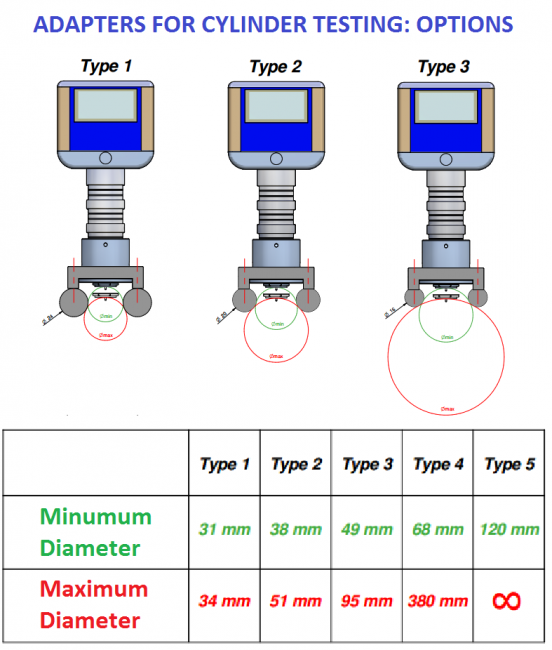
- For O-rings, seals, or other non-flat components: The IRHD method is, in our opinion, the superior choice. Think of the critical hydraulic seals in aerospace landing gear or the tiny, precise O-rings used in a medical device. On a curved surface, a Shore durometer can give a misleading reading, but the IRHD’s spherical tip is made for that exact job.
- For flat, thick rubber sheets and general production-line checks: We consistently recommend a Shore durometer. Consider the thick rubber on a conveyor belt or an anti-vibration pad for industrial machinery. For these applications, you need a fast, reliable reading to confirm a batch is within spec, and a Shore instrument provides that immediate feedback.
For compliance with specific standards (ISO, ASTM): The standard dictates the method. For instance, the widely-used automotive standard ASTM D2240 explicitly calls out the procedure for Shore testing. If your client requires adherence to that document, the choice is already made for you. We build our equipment to be fully compliant with these governing standards.
Related article: Elevating The Quality of Rubber Samples: Qualitest's Solution for Sika's Testing Needs
A Word of Caution on Conversion Charts like an IRHD to Shore A Conversion Table
While you will find tables online that offer conversions, they should not be treated as a substitute for direct testing. We have seen quality issues arise from teams relying on these approximations for final validation. This is why any irhd to shore a conversion table or irhd to shore d conversion table must be used with caution.
The reason is simple: the pointy Shore indenter and the rounded IRHD ball stress the material in different ways. Two materials could have the same Shore A value but show different IRHD readings due to their unique chemical composition. For any application where the result truly matters, using the correct instrument is the only way to be certain.
Below is a standard irhd to shore a conversion table for general reference.
| IRHD | Approximate Shore A |
|---|
| 40 | 39 |
| 50 | 49 |
| 60 | 62 |
| 70 | 68 |
| 80 | 80 |
| 90 | 90 |
Disclaimer: This table is for estimation purposes only.
Similarly, this irhd to shore d conversion table provides approximations for harder materials.
| IRHD | Approximate Shore D |
|---|
| 85 | 33 |
| 90 | 39 |
| 95 | 46 |
| 100 | 58 |
Disclaimer: This is an approximation. Use a dedicated Shore D instrument for accurate measurements.
Solve IRHD vs Shore with Qualitest
Ultimately, we provide more than just equipment; we provide confidence in your results. We know that selecting the right material is just the first step—verifying its properties with the right instrument is how you protect your quality standard. Our full range of durometers and hardness testers is built to meet the real-world needs of our clients.
Don't let inconsistent hardness data or confusion over IRHD vs Shore put your product's performance at risk. Investing in the correct testing procedure is far more cost-effective than dealing with a single product recall. Contact us to discuss the specific challenges you face. Our team of experts will help you find the perfect, cost-effective solution to solidify your quality control process.
Getting a material's hardness right is a critical factor for product performance.
An incorrect value can lead to a component that feels substandard or fails prematurely. This is the precise challenge the ASTM D2240 durometer test method was made to solve. Consider it the official procedure for a specific type of indentation test that confirms how resistant or pliable your materials are.
We’re going to outline this standard, look at its variations, and explain how you can achieve truly consistent numbers from your ASTM D2240 durometer.
So, What's the Idea Behind ASTM D2240?
At its core, this standard is about creating a common language. When a component supplier and a manufacturer agree on a hardness value, they need to be certain they are talking about the exact same thing. ASTM D2240 is the definitive rulebook that ensures everyone is on the same page.
The test itself uses a compact device called an ASTM D2240 durometer. This instrument has a pin that sticks out from a flat foot, connected to a spring. When you press the foot firmly against your material, the pin retracts, and the distance it retracts is shown on a dial or digital display.
But this is about more than just a pass/fail number. That number tells a story about the material’s likely performance. The hardness of a rubber seal relates to how well it will stop leaks; the hardness of a plastic casing points to its durability.
Related article: Understanding the Shore Hardness Test: Method, Formula & Diagram
At Qualitest, we guide clients to see this test as an essential first line of defense against material inconsistency. It's how you can spot a bad batch of raw material before it gets into your production process, saving a great deal of time and expense.
The Two Most Common Scales in ASTM D2240: Shore A and Shore D
The ASTM D2240 standard includes several scales, but the most common are ASTM D2240 Shore A and ASTM D2240 Shore D. Selecting the correct scale is absolutely essential.
- ASTM D2240 Shore A: This is the proper choice for softer, pliable materials like rubber seals and flexible silicones. The pin on an ASTM D2240 Shore A durometer has a flat tip, preventing it from puncturing the surface.
- ASTM D2240 Shore D: This scale is reserved for harder items like safety helmets and rigid plastics. The pin on an ASTM D2240 Shore D instrument is exceptionally sharp, a defined cone designed to make an impression on resistant surfaces.
Read more: Durometer Hardness: Shore A vs Shore D Differences
Based on the hundreds of labs we've equipped, we find that a straightforward, easy-to-read dial gauge like our Shore Durometer Model HD3000 is often the most practical and cost-effective instrument for most quality departments. For operations that require digital precision and data output, our Digital Shore Durometer DRIVE Series is an effective setup.
Global Standards: A Look at ISO 868 vs ASTM D2240
For manufacturers with a global client base, the conversation will eventually include ISO 868. This is the other major global standard for hardness, leading to the frequent ISO 868 vs ASTM D2240 discussion.
While the basic principle is the same, there are important distinctions a business needs to be aware of. The most significant difference in the ISO 868 vs ASTM D2240 comparison is scope: ASTM D2240 covers a very wide assortment of materials, while ISO 868 is specifically focused on plastics and ebonite.
| Feature | ASTM D2240 | ISO 868 |
|---|
| Primary Focus | A wide range of rubbers, elastomers, and plastics. | Specifically plastics and ebonite. |
| Geographic Prevalence | The dominant standard in North America. | The dominant standard in Europe and other regions. |
| Procedural Nuance | Tends to be more general in its application guidelines. | Can have more specific requirements for certain materials. |
From our standpoint, having the ability to test and certify to both standards is a powerful business advantage. It removes friction from international trade and streamlines supply chain conversations immensely; it's a topic our team frequently advises on.
Related article: Elevating The Quality of Rubber Samples: Qualitest's Solution for Sika's Testing Needs
A Process for Accurate ASTM D2240 Durometer Results
A reliable durometer is the starting point, but the accuracy of your results depends entirely on a disciplined process for your ASTM D2240 durometer.
Prepare the Specimen
Your material sample must be a minimum of 6mm thick with a completely flat surface. The reason for this thickness is to avoid the "sink-in" effect where the hard benchtop influences the reading. This is one of the first things we check when a client calls with inconsistent results.
Condition the Environment
A material's properties can be noticeably affected by temperature. The standard calls for testing in a controlled environment of 23°C ± 2°C (73.4°F ± 3.6°F) for this very reason. We consider this step fundamental for generating comparable data.
Apply the Instrument
The durometer’s base must sit perfectly flush with the material surface. You apply force quickly and firmly, but without any shock. This single action is the largest source of operator error we see. It is why we so strongly suggest an Operating Stand. It brings the durometer down onto the sample with a controlled speed and a consistent weight, taking the human variable completely out of the test and delivering the kind of reliability our clients expect.
Take the Reading
You should record the value within one second of full contact. For some materials, you will notice the needle "creep" backwards. If testing a material like this, you must use a consistent time delay for every test. Consistency is what separates a professional measurement from a guess.
Related article: Next-Level Hardness Testing: Unveiling The Automatic Durometer – Automatic Shore IRHD Hardness Tester
ASTM D2240 Durometer Solutions from Qualitest
Our entire focus at Qualitest is on removing the guesswork from quality control. We operate on the principle that your success depends on data you can fully trust. Our line of cost-effective ASTM D2240 durometer products delivers the accuracy you require, and our operating stands help ensure every measurement is repeatable.
We invite you to explore our collection of Shore durometers to see how our equipment can bring a higher degree of confidence to your manufacturing process. Get in touch, and one of our experienced engineers can help you identify the right solution for your specific needs.