Theory and Method
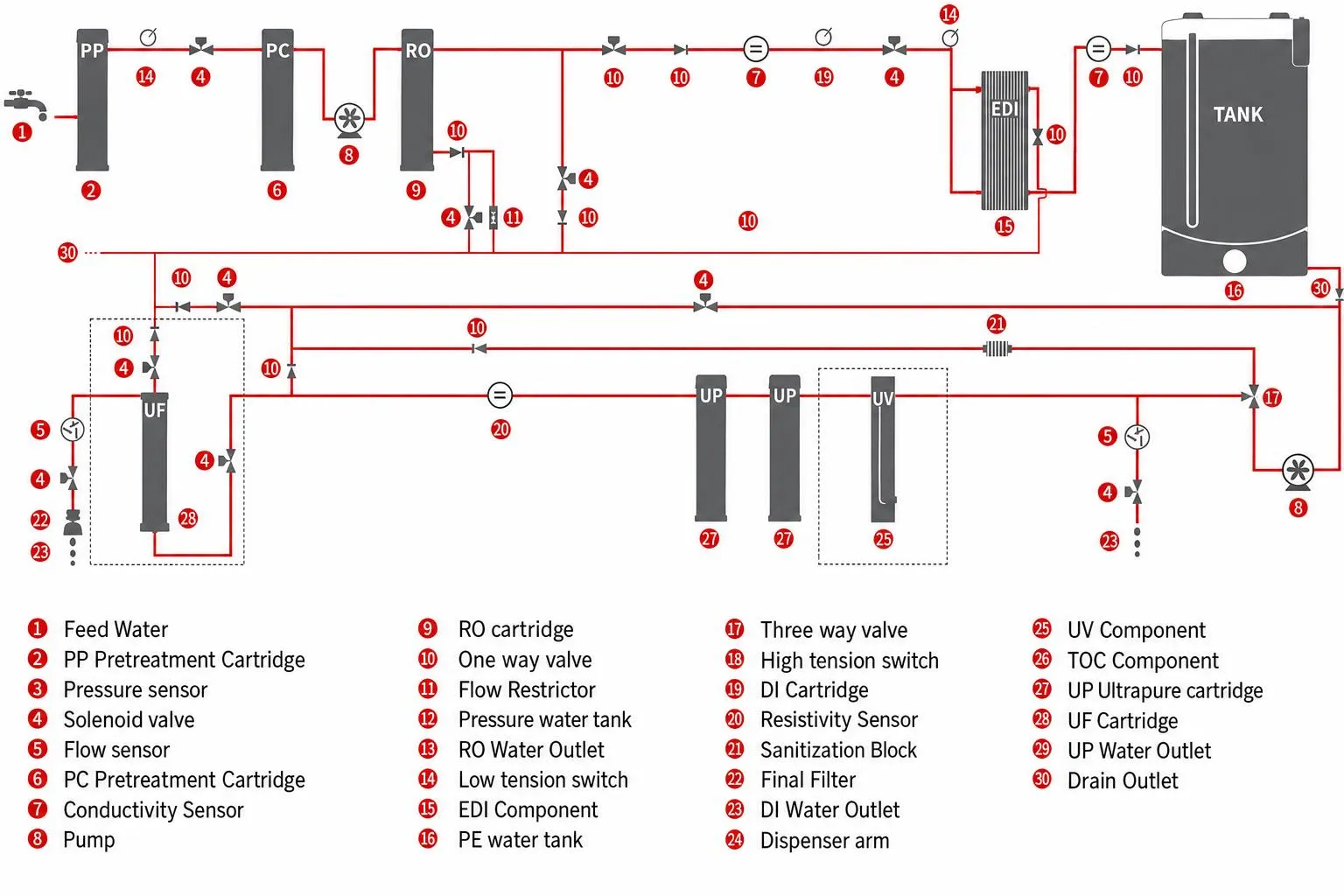
Pretreatment comes first for a mechanical reason. A 5 µm pleated depth filter holds suspended solids off the membrane face, and a catalytic activated carbon fiber filter removes residual chlorine, which degrades polyamide membrane chemistry on contact. Reverse osmosis then reverses the natural osmotic direction: pump pressure exceeds the osmotic pressure of the dissolved salts, water crosses the membrane, and 98% to 99% of the ionic load stays behind alongside organics above roughly 300 Daltons.
Most systems reaching Type I quality add a second RO pass at this point. Electrodeionization takes that role here instead. Resin sits between ion-selective membranes, a DC field draws cations toward the cathode and anions toward the anode through membranes that admit only matching charge, and both streams leave as a concentrate that drains away. Water splitting at the resin interfaces produces hydrogen and hydroxide ions that refresh the exchange sites as fast as they fill.
That difference shows in the numbers, and it is worth understanding before selecting a model. Fed from a single RO pass, the EDI stage carries a heavier ionic load than it would on double-pass permeate, so output is specified above 10 MΩ.cm rather than above 15. Actual performance commonly runs higher. What the module delivers regardless is a steady quality with no sawtooth between regenerations and no downtime for them.
Mixed-bed cartridges finish the ultrapure line. Three cartridges carry 4.08 liters of resin between them and strip the last ionic traces until resistivity approaches 18.18 MΩ.cm at 25°C, the ceiling water's self-ionization allows. Neutral species need other tools: 185 nm photons form hydroxyl radicals that oxidize dissolved organics for the resin to capture, 254 nm output breaks microbial DNA, and a PES membrane above 5000 Daltons screens endotoxin and nucleases by size.