For manufacturers and labs, the Rockwell method is the primary choice for checking material resistance. Unlike optical methods that demand measuring the width of an indentation, this approach measures depth. The result is a direct, immediate reading that keeps production lines moving and quality control efficient.
Whether you are checking heat-treated steel or softer alloys, getting the right data depends on following the correct protocol. This guide breaks down the fundamentals of the test, how to pick the right scale for your material, and the procedures required to meet ASTM E18 standards.
Key Takeaways
- Speed and Efficiency: The Rockwell method measures indentation depth rather than width to deliver immediate results without secondary calculations.
- Scale Selection: Matching the correct scale to your material is critical, with HRC commonly used for hard metals and HRB for softer alloys.
- Non Destructive Testing: This method leaves a minimal mark which allows operators to test finished components without damaging the final product.
- Industry Compliance: Valid testing requires strict adherence to ASTM E18 or ISO 6508 standards to ensure data integrity during audits.
- Versatile Equipment: Manufacturers can choose between high precision benchtop models for the lab or portable units for testing large parts in the field.
What is the Rockwell Hardness Test?
The Rockwell hardness test is a widely used method for assessing the hardness of materials. It provides valuable insights into the mechanical properties of a wide range of substances, making it an essential tool in industries such as manufacturing, engineering, and quality control.
The Rockwell hardness test is a measure of a material's resistance to indentation. It involves applying a minor preliminary load, followed by a major load through an indenter, usually a diamond or tungsten carbide ball. The resulting indentation depth is measured, and the hardness value is determined based on the depth and the applied load. This test is highly efficient, providing quick and reliable hardness measurements without causing significant damage to the tested material.
You might be curious, is the Rockwell hardness test destructive? One of its key advantages is its non-destructive nature. Unlike certain other hardness testing methods, such as the Brinell test, the hardness test Rockwell creates a small, localized indentation that does not significantly alter the material's structural integrity. This non-destructive characteristic makes it suitable for evaluating the hardness of finished products, where minimal damage or deformation is desired.
While traditional Rockwell hardness testers are stationary machines, recent advancements have introduced handheld and portable versions of these instruments. Handheld Rockwell hardness tester offers the convenience of mobility and is ideal for on-site hardness testing. They are lightweight, compact, and easy to operate, allowing users to obtain hardness measurements directly in the field. The portable Rockwell C hardness tester, on the other hand, provides the added advantage of measuring hardness on curved or large surfaces. Their versatility and adaptability make them valuable tools for industries that require flexibility in hardness testing.
The Rockwell hardness test is a widely adopted method for evaluating the hardness of materials. Its non-destructive nature, quick results, and versatility make it an invaluable tool across various industries. Whether using traditional stationary machines or the more recent handheld and portable versions, Rockwell hardness testers provide reliable and efficient hardness measurements. By understanding the fundamentals of the Rockwell hardness test and the different types of hardness testers available, professionals can make informed decisions regarding material selection, quality control, and process optimization.
Related article: Superficial vs Regular Rockwell: The Technical Guide
Quick Reference: Selecting the Right Scale
Different materials respond better to specific loads and indenters. Use this chart to match your application with the correct Rockwell scale.
Related article: Rockwell Test Precision: Loads, Indenters & Results
| Scale Symbol | Indenter Type | Major Load (kgf) | Typical Use Case |
|---|
| HRA | Diamond Cone | 60 | Cemented carbides, thin steel, and shallow case-hardened steel. |
| HRB | 1/16" Steel Ball | 100 | Copper alloys, soft steels, aluminum alloys, and malleable iron. |
| HRC | Diamond Cone | 150 | Hardened steel, titanium, and heat-treated materials (most common for hard metals). |
| HRD | Diamond Cone | 100 | Thin steel and medium-case hardened steel where HRC might be too heavy. |
| HRE | 1/8" Steel Ball | 100 | Cast iron, aluminum and magnesium alloys, and bearing metals. |
| HRF | 1/16" Steel Ball | 60 | Annealed copper alloys and thin soft sheet metals. |
Rockwell Hardness Test Procedure: A Step-by-Step Guide
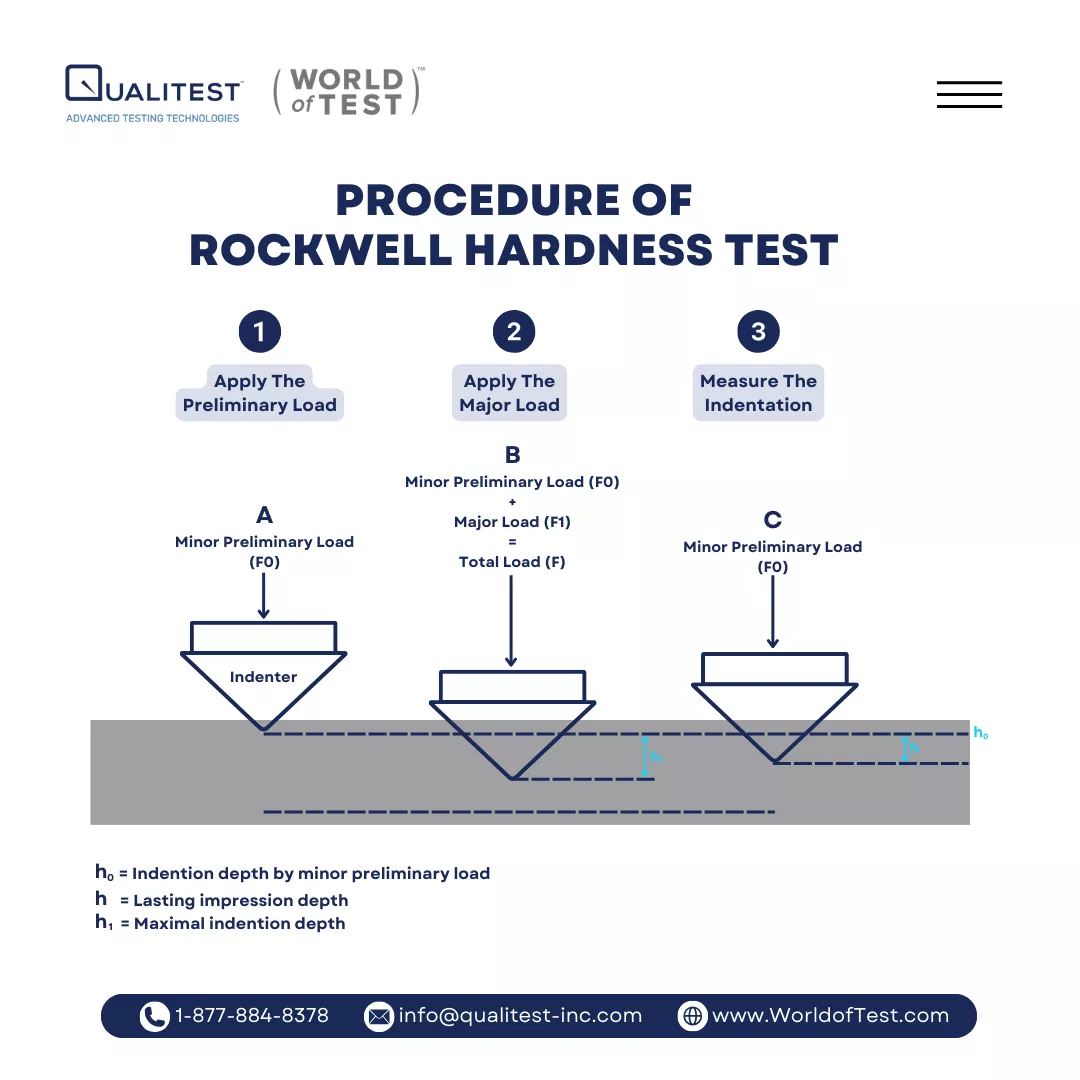
The Rockwell hardness test is a standardized method used to measure the hardness of materials. It provides valuable information about a material's resistance to indentation and is widely utilized in industries such as manufacturing, engineering, and quality control.
How Does the Rockwell Hardness Test Work?
The Rockwell hardness test works by measuring the depth of indentation produced by a cone-shaped diamond as an indenter under a specific load. The test begins with the application of a minor preliminary load, followed by the major load.
The major load is maintained for a specific duration, allowing the indenter to penetrate the material's surface. After removing the load, the remaining indentation depth is measured, providing the basis for determining the material's hardness value to be calculated.
Read more: Rockwell Testing Methods: Formulas & Usage
How to Use a Rockwell Hardness Tester?
To perform a Rockwell hardness test, follow these general steps:
- Prepare The Sample: Ensure the surface of the sample is clean, flat, and free from any contaminants. Position the sample securely on the anvil of the Rockwell hardness tester.
- Select The Indenter And Test Scale: Depending on the material and desired hardness range, choose the appropriate indenter and test scale (e.g., Rockwell A, B, C, etc.).
- Apply The Preliminary Load: Activate the Rockwell hardness tester to apply the minor preliminary load, which sets the initial reference position.
- Apply The Major Load: Activate the tester again to apply the major load for a specific duration.
- Measure The Indentation: After removing the load, measure the remaining indentation depth using the depth-measuring mechanism of the Rockwell hardness tester.
- Read The Hardness Value: Refer to the Rockwell hardness test chart, which correlates the indentation depth with the corresponding hardness value for the specific test scale and indenter used. Record the hardness value for the material.
Interpreting the Results with a Rockwell Hardness Test Chart
A Rockwell hardness test chart provides a reference for interpreting the recorded indentation depth into a corresponding hardness value. The chart typically includes different scales (e.g., Rockwell B, C, and others) and corresponding hardness values based on the load and indenter used. By locating the indentation depth on the chart, one can determine the hardness value of the material.
How to Calibrate a Rockwell Hardness Tester
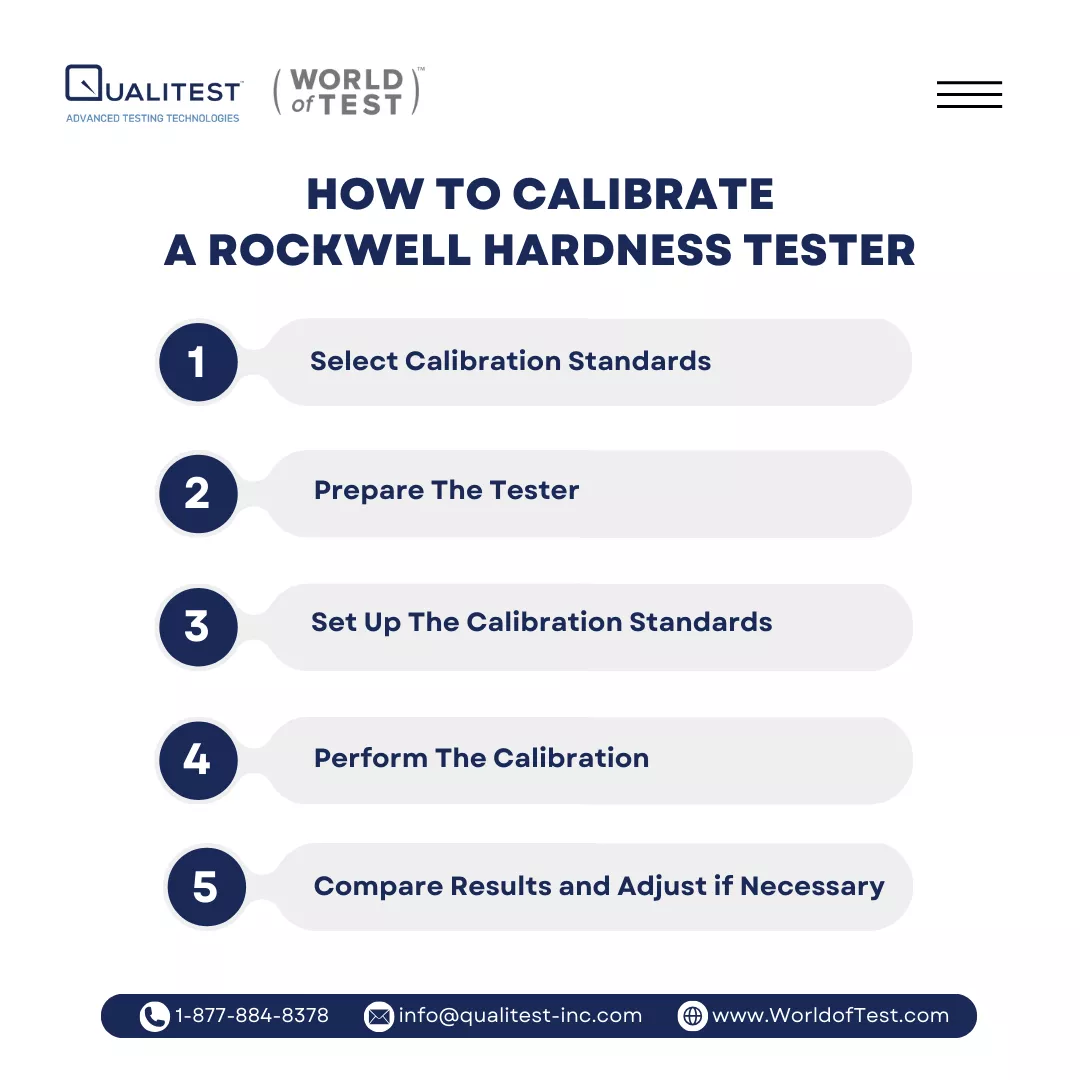
Calibrating a Rockwell hardness tester is essential to establish a reference point for accurate hardness measurements. Over time, factors such as wear and tear, mechanical drift, and environmental conditions can affect the performance of the tester, leading to deviations in hardness readings.
Regular calibration ensures that the tester is aligned with recognized standards and provides reliable results, preserving the integrity of hardness testing data. Follow These steps if you want to calibrate a Rockwell Hardness Testing machine:
- Select Calibration Standards: Obtain certified hardness test blocks or reference samples that have known and traceable hardness values. These blocks should cover the desired hardness range for calibration.
- Prepare The Tester: Ensure that the Rockwell hardness tester is clean and in proper working condition. Check that all components, including the indenter, anvil, and load application system, are free from damage or defects.
- Set Up The Calibration Standards: Place the calibration standards on the anvil of the instrument. Ensure they are securely positioned and aligned with the tester's indenter.
- Perform The Calibration: Follow the operating instructions provided by the manufacturer to apply the test load to the calibration standards. Record the indentation depths and corresponding hardness values as indicated by the Rockwell hardness test chart.
- Compare Results and Adjust if Necessary: Compare the measured hardness values obtained during calibration with the known values of the calibration standards. If there are any discrepancies, consult the manufacturer's guidelines for adjusting the tester to align with the desired values.
Regular calibration is not a one-time process; it should be performed at specified intervals to maintain the accuracy and reliability of the Rockwell hardness tester. Factors such as frequency of usage, environmental conditions, and industry regulations may influence the recommended calibration schedule
Adhering to the calibration schedule and maintaining proper documentation of calibration activities ensure traceability and uphold the integrity of hardness testing performed using the Rockwell hardness tester.
What is the Standard for the Rockwell Hardness Test?
The Rockwell Hardness Test, a widely recognized method for assessing material hardness, adheres to stringent standards established by organizations such as ASTM International and the International Organization for Standardization (ISO). These standards provide guidelines for conducting the test, ensuring consistency and accuracy across industries.
One common question in hardness testing is whether a higher HRC value indicates greater hardness. For instance, is 45 HRC harder than 60 HRC? The answer lies in understanding that HRC (Rockwell Hardness on the C scale) measures the hardness of steel and other metallic materials. In this context, a higher HRC value indeed indicates greater hardness. Therefore, 60 HRC is harder than 45 HRC.
Another query often arises regarding the comparison between Rockwell B and Rockwell C hardness scales. Which is harder Rockwell B or C? While both scales measure material hardness, Rockwell C is typically used for harder materials, while Rockwell B is suitable for softer materials such as aluminum alloys, brass, and softer steels. Therefore, when considering which is harder between Rockwell B and C, it depends on the material being tested.
Regarding standards, ASTM standards for Rockwell hardness testing are ASTM E18 and ASTM D785. ASTM E18 and ISO 6508 outline the standardized test methods for metals, ensuring consistency and accuracy in Rockwell hardness testing.
In the plastics industry, Rockwell hardness testing is governed by ASTM D785 and ISO 2039-2. ASTM D785 specifies the test method for determining the Rockwell hardness of plastics and elastomers using the Rockwell hardness scales. ISO 2039-2 is the international standard for Rockwell hardness testing of plastics and provides guidelines for the test procedure and the interpretation of hardness values.
Advantages and Disadvantages Of the Rockwell Hardness Test
The Rockwell hardness test is a widely adopted method for evaluating the hardness of materials, especially metals. It provides numerous advantages that have made it a preferred choice across various industries. However, it's crucial to acknowledge its limitations and potential drawbacks. Let's delve into both the advantages and disadvantages of this hardness test.
Advantages Of Rockwell Hardness Test
- Immediate Results: Unlike optical methods that require measuring the indentation diameter under a microscope, the Rockwell test provides a direct hardness reading the moment the load is removed. This speed is critical for high-volume production lines.
- Minimal Surface Preparation: While a clean surface is necessary, the Rockwell method is more forgiving than Vickers or Micro-hardness testing. It typically requires less polishing and grinding, saving significant prep time.
- Non-Destructive Nature: The indentation left by the diamond or ball indenter is small and localized. This allows quality control teams to test finished components without compromising their structural integrity or function.
- Broad Material Application: By simply changing the indenter and load (e.g., swapping from HRC to HRB), a single machine can test materials ranging from soft aluminum and plastics to hardened steel and carbides.
- Operator Simplicity: The automated nature of modern Rockwell testers reduces the risk of human error. Operators do not need to interpret visual data, ensuring consistent results regardless of experience level.
- Location Flexibility: The test is no longer confined to the laboratory. With portable and handheld models available, operators can perform accurate testing on large pipelines, installed machinery, or heavy parts directly on the shop floor.
Disadvantages of the Rockwell Hardness Test
- Material Uniformity: The small indentation size is less effective for materials with coarse or non-homogeneous structures (e.g., cast iron). The Brinell method is often better suited for averaging out these inconsistencies.
- Surface Sensitivity: Rough or scaled surfaces can skew depth measurements. Additionally, testing curved surfaces (like shafts) requires applying a specific correction factor to obtain valid data.
- Thickness Constraints: If a sample is too thin for the applied load, the test may measure the support anvil's hardness rather than the part's (known as the "anvil effect").
- Soft Material Limits: The method is not suitable for extremely soft materials or very thin foils. Micro-hardness testing (Vickers or Knoop) is the standard alternative for those applications.
Rockwell Hardness Test vs Brinell Hardness Test: A Comparative Analysis
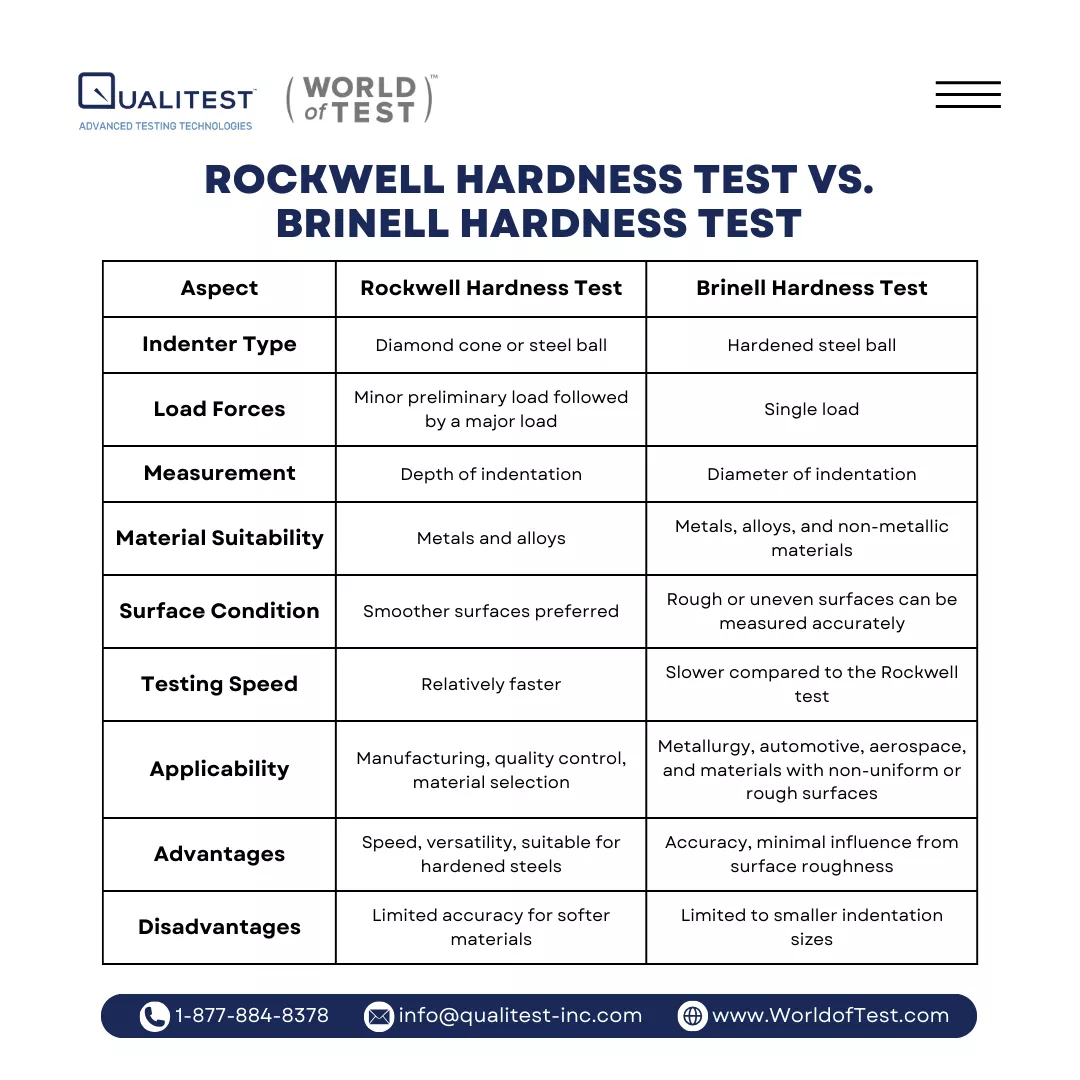
When it comes to hardness testing, two widely used methods are the Rockwell Hardness Test and the Brinell Hardness Test. Let's explore how these methods compare and their respective advantages, Rockwell hardness test vs Brinell.
The Rockwell Hardness Test and the Brinell Hardness Test are both used to assess the hardness of materials, but they differ in their testing procedures and application areas. In the Rockwell Hardness Testing, a minor and a major load are applied successively to the material surface, and the depth of penetration is measured. This method offers quick results and is suitable for a wide range of materials, including metals, plastics, and composites.
On the other hand, the Brinell Hardness Test involves applying a single, larger load to the material surface using a hardened steel ball indenter. The diameter of the resulting indentation is measured to determine the material's hardness. While the Brinell Hardness Test provides accurate results, it is more suitable for softer materials and may require a longer testing time compared to the Rockwell method.
When comparing the two tests, several factors come into play. The Rockwell Hardness Tester is preferred for its speed, versatility, and ability to test a variety of materials efficiently. This tester is suitable for various industrial applications, including manufacturing, quality control, and material selection. It is particularly useful for measuring the hardness of hardened steels and alloys.
In contrast, the Brinell Hardness Test is known for its accuracy and suitability for testing softer materials. This tester provides accurate results, especially for materials with non-uniform structures or rough surfaces. It finds applications in industries such as metallurgy, automotive, and aerospace, where accurate measurements of material hardness are essential.
Depending on the material being tested and the specific requirements of the application, engineers and technicians may choose either method based on their needs. To learn more about this, you can refer to the Brinell vs Rockwell hardness test compare table above.
Understanding the differences and advantages of each test allows professionals to choose the appropriate method based on the material type, surface condition, and specific testing requirements. Both tests play crucial roles in quality control, material selection, and process optimization in various industries.
Application of Rockwell Hardness Test in Various Industries
The Rockwell Hardness Test has found widespread application across diverse industries due to its versatility, accuracy, and efficiency in assessing material hardness. Let's explore how the Rockwell Hardness Test is utilized in different sectors:
1. Manufacturing Industry
In manufacturing, the Rockwell Hardness Test is crucial for quality control and material selection. It ensures that components and materials meet specified hardness requirements, thereby enhancing product reliability and performance. Manufacturers of automotive parts, machinery, tools, and consumer goods rely on Rockwell Hardness Testing to maintain consistent product quality.
2. Aerospace and Defense
Aerospace and defense industries utilize the Rockwell Hardness Test to assess the hardness of materials used in aircraft components, missile casings, armor plating, and other critical applications. By ensuring the hardness and integrity of materials, Rockwell Hardness Testing helps enhance the safety and durability of aerospace and defense systems.
3. Metallurgy
In metallurgical laboratories, the Rockwell Hardness Test is an essential tool for characterizing the mechanical properties of metals and alloys. It aids in research and development, quality assurance, and failure analysis processes, allowing metallurgists to optimize material compositions and manufacturing processes for specific applications.
4. Construction and Engineering
Construction companies and engineering firms rely on the Rockwell Hardness Test to evaluate the hardness of structural materials such as steel beams, concrete reinforcements, and welding joints. By assessing material hardness, engineers can ensure the structural integrity and longevity of buildings, bridges, and infrastructure projects.
5. Electronics
In the electronics industry, the Rockwell Hardness Test is employed to assess the hardness of materials used in electronic components, circuit boards, connectors, and housings. By evaluating material hardness, manufacturers can ensure the reliability and longevity of electronic devices in various environments.
6. Automotive
Automotive manufacturers and suppliers utilize the Rockwell Hardness Test to evaluate the hardness of engine components, transmission parts, chassis components, and automotive fasteners. This ensures that materials meet performance standards for durability, reliability, and safety in-vehicle applications.
7. Medical and Pharmaceutical Industries
In the medical and pharmaceutical industries, the Rockwell Hardness Test is used to evaluate the hardness of materials used in implants, surgical instruments, and medical equipment. Ensuring the appropriate hardness of these materials is critical for patient safety and device performance.
8. Plastics and Polymers
Although primarily designed for metal testing, the Rockwell Hardness Test can also be adapted for testing certain plastics and polymers. Industries involved in manufacturing plastic components, packaging materials, and polymer-based products utilize Rockwell Hardness Testing to assess material hardness and quality.
The Rockwell Hardness Test finds extensive application across industries ranging from manufacturing and metallurgy to medical devices and polymers. Its versatility and reliability make it a valuable tool for ensuring material quality, performance, and safety in various industrial sectors.
Find The Most Suitable Rockwell Hardness Tester for Your Application at Qualitest

When it comes to Rockwell hardness testing, having a reliable and accurate hardness tester is essential to obtain precise and consistent results. Qualitest, a trusted provider of testing equipment, offers a range of Rockwell hardness testers suitable for various applications.
For those seeking portability and convenience, our Portable Hardness Tester is an excellent choice. This compact and versatile device allows for on-the-go hardness testing, making it ideal for field applications and hard-to-reach areas.
If digital precision is what you require, consider our Digital Rockwell Hardness Tester from the Rocky Series. Featuring advanced digital technology, this tester delivers accurate and repeatable hardness measurements with ease.
Related article: Digital vs Analog Rockwell Tester: Which is Better?
For laboratories and industrial settings demanding top-notch performance, our Rockwell Hardness Tester models such as the QualiRock and QualiRock Auto offer exceptional reliability and efficiency. These testers are designed to meet the rigorous demands of quality control and material analysis applications.
Looking for versatility and flexibility? Our Universal Hardness Tester - QualiUniversal is your solution. With its ability to perform multiple hardness tests, including Rockwell, Brinell, and Vickers, this tester offers unmatched versatility for a wide range of materials and applications.
If you prefer analog instrumentation, our Analog Rockwell Hardness Tester - HardRocker combines simplicity with precision, providing reliable hardness measurements with intuitive operation.
For challenging testing environments and hard-to-access areas, our Hardness Tester MTR X-SERIES is your go-to solution. Engineered for durability and reliability, this tester excels in applications that traditional testers may struggle to reach.
At Qualitest, we understand the importance of selecting the right Rockwell Hardness Tester for your specific needs. With our diverse range of models and expert support, finding the best solution for your hardness testing requirements has never been easier.
Contact us today to explore our full range of Rockwell Hardness Testers for sale and discover the perfect fit for your testing needs.
References:
- Varol, K., & Kalaycıoglu, B. (2025). Friction dependence of measured hardness: Brinell vs. Rockwell indentation tests. Metallurgical Research & Technology.
- Chen, B., Leiste, U., Chen, Q., Fourney, W., & Li, T. (2022). Correlation between Rockwell and Brinell Hardness Measurements. Journal of Applied Mechanics.
- Kuzu, C., Pelit, E., & Meral, I. (2023). INSTALLATION AND METROLOGICAL CHARACTERIZATION OF ROCKWELL-BRINELL-VICKERS HARDNESS STANDARD MACHINE AT TÜBİTAK UME. Proceedings of the 14th IMEKO TC5 Conference on Measurement of Hardness.
- Richardson, J. (2025). Hardness Testers: Know the Options for Best Results. AM&P Technical Articles.
- Guštin, A., Žužek, B., Podgornik, B., & Kevorkijan, V. (2019). The uncertainty of hardness measurements related to the measurement method, surface preparation and range of the measurements. Materiali in Tehnologije, 53, 897-904.
- Petrenko, S. (1927). Relationships between the Rockwell and Brinell numbers.
- Vaganova, O., Kutepova, L., Smirnova, Z., Lapshova, A., & Chelnokova, E. (2020). Testing the hardness of materials by Brinell and Rockwell methods. International Journal of Emerging Trends in Engineering Research.
- Tak, N., Lee, H., & Bahng, G. (2013). Effects of differences in hardness measurement procedures on the traceability chain and calibration process. Metrologia, 50, 249 - 256.
